Compared
Otterly vs MarketMuse
Otterly is a AI search monitoring; MarketMuse is a content strategy platform. This guide compares the two in depth, engine coverage, tracking mechanics, content production, SEO and local surfaces, data access and full pricing tiers, using only facts read from their live pages.
01
The short answer
Otterly monitors AI search on four base engines with audits and recommendations: mentions, sentiment, citations, a crawlability checker and prompt research. MarketMuse, part of Siteimprove, models Google's results pages: topic modeling with personalized difficulty, research-backed briefs, draft scoring against the top 20, and site-wide content inventory. They compete only where the categories overlap, and the chapters below walk every dimension a buyer would price: which AI engines each can see, how the tracking actually meters, what each produces on the content side, what surrounds the core product, and the full published tier lists.
Choose Otterly when
- Copilot coverage in the base plan
- Gartner Cool Vendor for AI in Marketing 2025
- Metered API and MCP from the $189 tier
- ChatGPT Ads and Shopping tracking
Choose MarketMuse when
- Site-wide content inventory with decay tracking
- Topic models with difficulty personalized to your domain
- 1:1 draft scoring with E-E-A-T signal measurement
- All nine brief types on the Strategy tier
02
What Otterly is
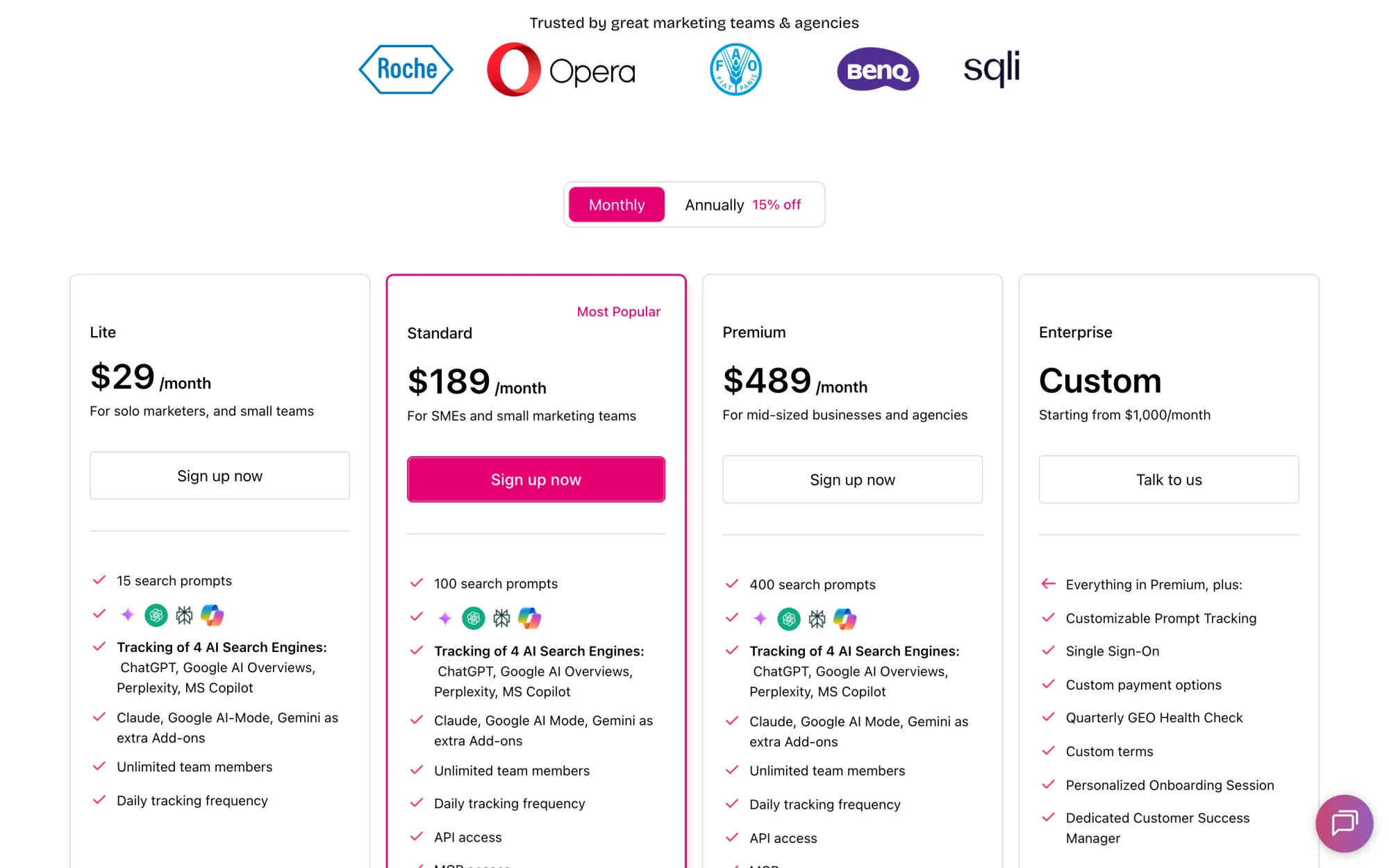
Otterly is an AI search monitoring tool with real credentials: a Gartner Cool Vendor for AI in Marketing in 2025, a 4.8 rating badge, and 30,000+ marketing professionals by its own count, with Roche, Opera and BenQ among the logos on its pricing page. The surface covers brand mentions, sentiment and citations tracked daily, a Brand Visibility Index, domain citation tracking updated weekly, AI prompt research, a crawlability checker, content audits with specific improvement recommendations, and ChatGPT Ads and Shopping tracking.
Pricing model. Lite $29, Standard $189 and Premium $489 a month with 15% off annually and four engines included on every tier; Claude costs $29 to $439 a month extra by tier, Gemini and Google AI Mode $9 to $149 each, and Enterprise starts from $1,000 a month.
| Otterly plan | Price | What the page says |
|---|---|---|
| Lite | $29/mo | 15 prompts, 4 engines, no API or MCP |
| Standard | $189/mo | 100 prompts; API + MCP at 2,000 requests/mo each; Looker |
| Premium | $489/mo | 400 prompts; API + MCP at 5,000 requests/mo |
| Enterprise | from $1,000/mo | custom prompt tracking, SSO, GEO health checks |
Tier facts rendered from otterly.ai/pricing, August 2026.
03
What MarketMuse is
MarketMuse, now by Siteimprove, is a content strategy platform with a decade of iteration on modeling Google's results pages: Topic Navigator, SERP x-ray, SERP and Site Heatmaps, topic models that produce difficulty scores personalized to your domain, and a Content Inventory that crawls your whole site and tracks decay. Its Optimize product scores a page one-to-one against the top 20 ranking pages with E-E-A-T signal measurement, and its brief generator produces research-backed briefs in nine types on the top tier.
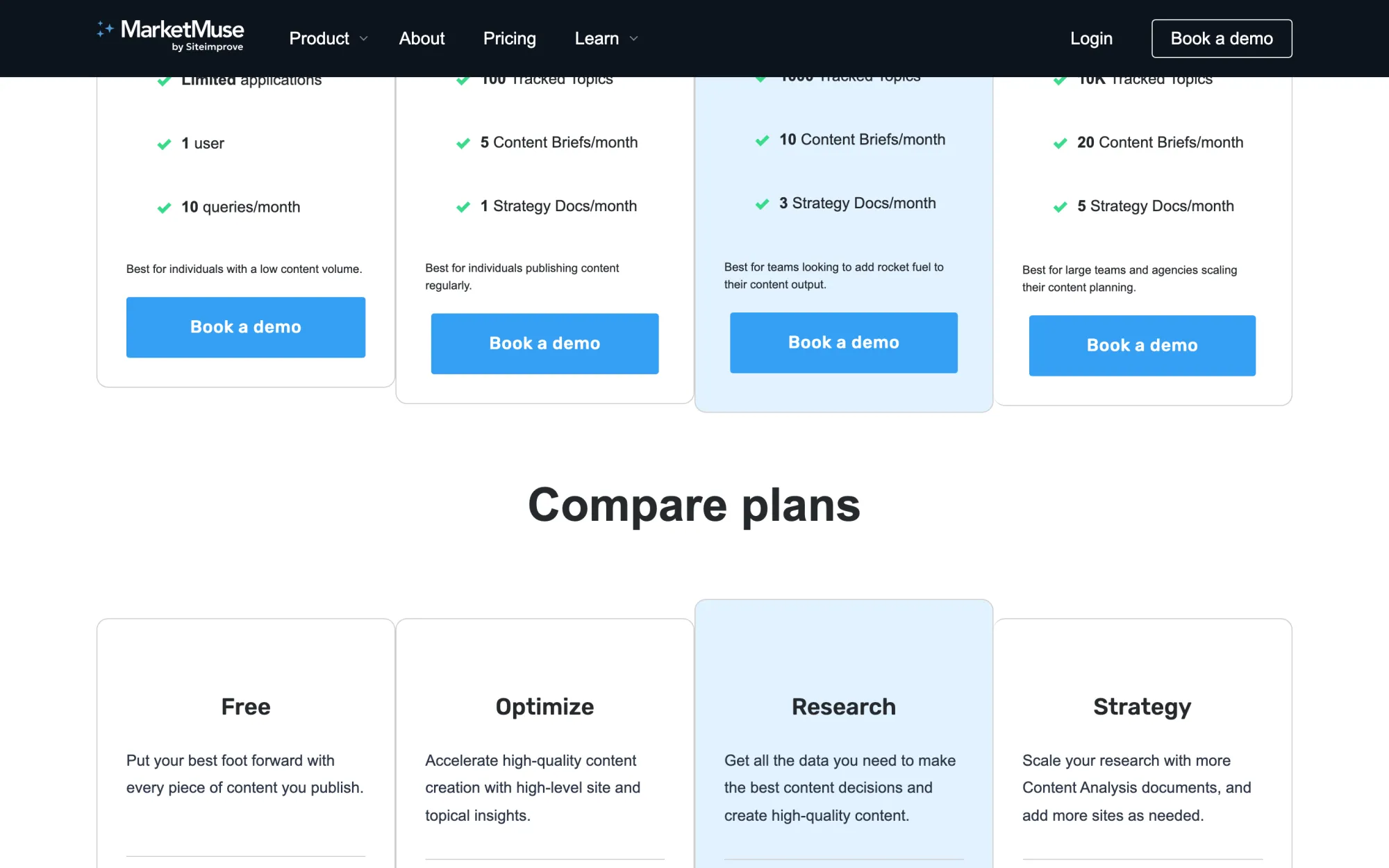
Pricing model. Four tiers, Free, Optimize, Research and Strategy, metered by tracked topics (10 queries a month free, 100 to 10,000 topics paid) and content briefs (5 to 20 a month); no dollar figures are published and every tier's button, including Free's, books a demo.
| MarketMuse plan | Price | What the page says |
|---|---|---|
| Free | No price published | 1 user, 10 queries/month; demo call to start |
| Optimize | No price published | 100 tracked topics, 5 briefs/mo, 1 strategy doc |
| Research | No price published | 1,000 topics, 10 briefs, unlimited queries |
| Strategy | No price published | 10K topics, 20 briefs, all 9 brief types |
Tier facts rendered from marketmuse.com/pricing, August 2026.
04
AI engine coverage
Otterly. Four engines are included on every tier, verbatim from the pricing cards: ChatGPT, Google AI Overviews, Perplexity and MS Copilot. Claude, Google AI Mode and Gemini are sold as add-ons, with Claude at $29, $109 or $439 a month by tier and Gemini and AI Mode at $9, $59 or $149 each; Grok and DeepSeek appear on neither list.
MarketMuse. No AI answer engine appears anywhere on MarketMuse's public pages: no ChatGPT, Claude, Gemini, Perplexity or AI Overviews. The platform's entire measurement surface is Google's results pages.
Summarized: Otterly reads 4 included (ChatGPT, AIO, Perplexity, Copilot); Claude, Gemini, AI Mode as add-ons; MarketMuse reads none; the surface is Google's SERPs. On Claude specifically, Otterly: add-on, $29 to $439/mo; MarketMuse: no.
05
Tracking and measurement mechanics
Otterly. Prompt runs are daily on every tier, 15 prompts on Lite up to 400 on Premium, with extra prompts at $99 per 100 on the upper tiers. Domain Citation Tracking refreshes weekly per the features page, and sentiment classification tags mentions as enthusiastic, with caveats, or dismissed.
MarketMuse. Measurement is SERP analysis at depth: SERP x-ray and heatmaps, topic models with personalized difficulty, and the Content Inventory crawling your site to flag decay. There is no position tracker in the rank-tracking sense and no answer recording.
06
Content production
Otterly. The optimization surface is audit and advice: a content audit that produces specific improvements, a crawlability checker, prompt research and recommendations. There is no long-form writer and no CMS publishing anywhere on the public pages, so the output is a to-do list for your team.
MarketMuse. Briefs are the product: structure, subtopics, questions and linking suggestions, research-backed, metered per month by tier, with draft scoring against the top-20 pages. Output exports to Google Docs or MS Word for your writers; there is no CMS publishing, so the distance from brief to published page runs through your team.
07
SEO and local coverage
Otterly. There is no Google organic rank tracker and no local surface of any kind on the public pages; the product's scope is AI search.
MarketMuse. There is no local product: no map tracking, no GBP tooling, no citations.
08
Data access, APIs and integrations
Otterly. API and MCP access ship from the $189 Standard tier, metered at 2,000 requests a month each (5,000 on Premium), with a Google Looker Studio connector on the same tiers and CSV exports on every tier.
MarketMuse. No public API documentation exists (the /api page 404s and the developer subdomain refused connections when checked) and no MCP server is listed. Exports cover saved writing, applications and documents.
09
The full ledger
Every cell below was read from the vendors’ own rendered pages as of August 2026. Where a vendor’s public pages neither confirm nor deny a capability, the cell says so.
| Dimension | Otterly | MarketMuse |
|---|---|---|
| AI engines | 4 included (ChatGPT, AIO, Perplexity, Copilot); Claude, Gemini, AI Mode as add-ons | None; the surface is Google's SERPs |
| Claude coverage | Add-on, $29 to $439/mo | No |
| Tracking cadence | Daily prompts; citation tracking weekly | SERP analysis, not answer tracking |
| Google rank tracking | None | SERP modeling, no position tracker |
| Local / map tracking | None | None |
| Content output | Audits and recommendations | Briefs and scored drafts, exported to Docs/Word |
| CMS publishing | No | No (exports to Google Docs / MS Word) |
| API / MCP | API and MCP from the $189 tier, metered | No public API docs; no MCP |
| Entry price | $29/mo | Demo call required, including for Free |
Sources: otterly.ai, /pricing, /features; marketmuse.com/pricing and product pages. Rendered in a browser, August 2026.
10
Frequently asked
What is the core difference between Otterly and MarketMuse?
How does Otterly's pricing compare to MarketMuse's?
Which AI engines does each cover?
Who should pick Otterly?
Who should pick MarketMuse?
How does Rank.ai compare to Otterly and MarketMuse?
How each compares to Rank.ai
We keep our own product out of this comparison. If you want the same verified treatment with Rank.ai in the frame, the one-on-one guides for Otterly and MarketMuse carry it.