Compared
Rank.ai vs MarketMuse
MarketMuse plans content and scores drafts against Google's results, priced by demo call. Rank.ai records what seven AI engines answer about your market, then writes and publishes the missing pages, from $0 with no card. This guide walks both products screen by screen.
01
The short answer
MarketMuse is a content strategy platform with real depth: site-wide content inventory, topic models with difficulty scores personalized to your domain, and draft scoring against the top 20 ranking pages. All of it reads one surface, Google’s results pages, and all of it ends in an exported document a human writer still has to turn into a published page. Rank.ai covers the surface MarketMuse cannot see and finishes the work MarketMuse hands back: seven AI engines queried daily, every answer recorded with its cited sources on boards anyone can open, Google and local map rankings on the same login, and finished articles published into your CMS after you approve them.
Choose Rank.ai when
- AI answers are part of how your buyers decide
- The output you are paying for is a published page
- You want published prices and same-day checkout
- Local map rankings belong on the same bill
Choose MarketMuse when
- Deep topic modeling and content inventory drive your planning
- Human writers want 1:1 draft scoring with E-E-A-T signals
- Site-wide content decay monitoring is a core need
- A sales-led evaluation fits how your team buys
02
What each platform does
MarketMuse, now part of Siteimprove, models Google’s results pages: Topic Navigator, SERP x-ray, SERP and Site Heatmaps, research-backed content briefs and draft scoring. Its output is strategy documents and briefs that export to Google Docs or MS Word for your writers.

Rank.ai is built around the recorded answer: seven engines asked your market’s buying questions daily, every answer stored with its brands and citations, gaps fed into an article pipeline that writes, illustrates and publishes into WordPress, Webflow, Shopify or WordPress.com, and Google plus local rank tracking on the same login.
03
The decision surface MarketMuse cannot see
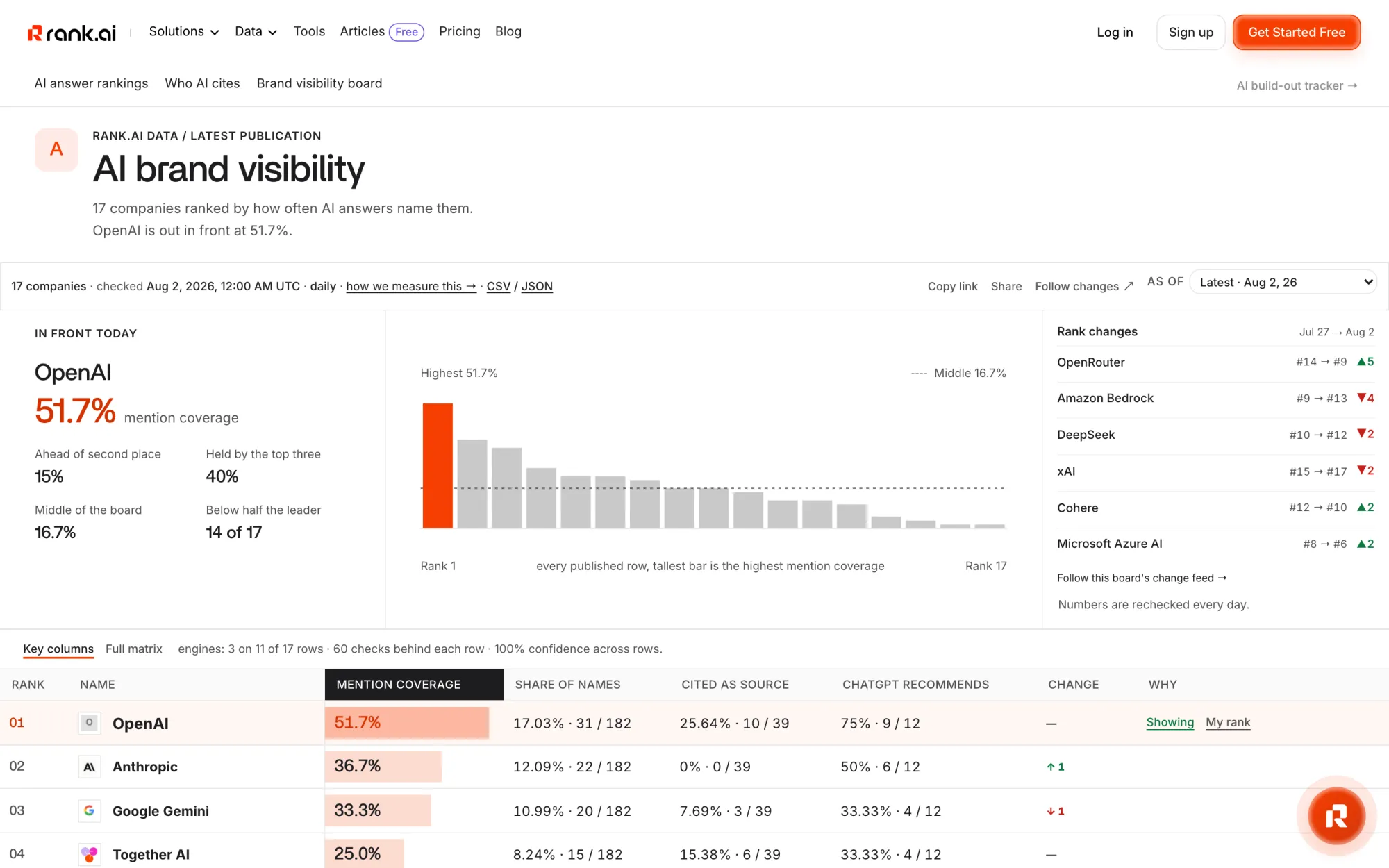
When a buyer asks ChatGPT which vendor to pick, that answer is the shortlist. MarketMuse never sees it: their platform models Google’s results pages and nothing else. Rank.ai puts the real buying questions in your market to ChatGPT, Claude, Gemini, Perplexity, Grok, Google AI Overviews and DeepSeek every day, running each question as multiple samples per engine because the same prompt answers differently run to run. Each run stores the full answer text, every brand it names with the exact sentence and a sentiment call on that specific mention, and every source URL it cites with its position and an attribution flag: yours, a tracked competitor’s, or neutral. For engines that search the web before answering, the record includes the Google queries the model issued under the hood, the searches your page has to win to make it into the answer.
04
From exported brief to published page
Walk one piece of content through each product and the category difference stops being abstract. In MarketMuse, the topic model proposes a subject and the brief generator produces a genuinely good brief: structure, subtopics, questions to answer, linking suggestions, all research-backed. Then the brief leaves the product. Their own pages describe the handoff: export to Google Docs or MS Word for your writers. Now it needs a writer for the draft, days of turnaround, an editing pass, a paste into the CMS, formatting rebuilt by hand, images found and licensed, internal links added, and someone to press publish. Every step is a person, a queue and a delay, and MarketMuse meters the start of that gauntlet: the Optimize tier includes 5 briefs a month, each one still unwritten when it arrives.
The Rank.ai pipeline starts from a sharper signal and finishes the whole distance. The topic comes from recorded AI answers and rankings: questions where you are absent and no strong source exists. The research pass reads live search results and the pages engines already cite. The draft is written in full, in your voice, from writing examples you paste in once, steered by title and style direction you set in plain text. An editorial loop revises each section against the research before you see it. Images are generated per section on your brand palette. A competitor-domain blacklist guarantees the article never links to a rival, subdomains included. Then it publishes into your CMS, on approval or on a weekly cadence you set once. On MarketMuse’s meter, a month on Optimize ends with 5 briefs waiting for writers. Here the $0 plan ends the month with 10 articles live on your site.
05
Local map rankings on the same login
MarketMuse has no local product: no map tracking, no Google Business Profile monitoring, no citations. If you run locations or serve local clients, that is a second tool and a second bill before you start. Rank.ai’s local rank tracker places a grid of probe points across each service area and checks map-pack rank from every one of them daily, with each tracked competitor’s rank recorded on the same grid. One credit per grid point, so a 3x3 scan costs 9 credits and a 10x10 costs 100. It tracks Google Maps and Apple Maps, grades your Business Profile and monitors your directory citations.
06
Pricing in practice
MarketMuse’s pricing page names four tiers, Free, Optimize, Research and Strategy, metered by tracked topics and briefs per month. No dollar figures appear on the page, and every tier’s button, including Free’s, books a demo.
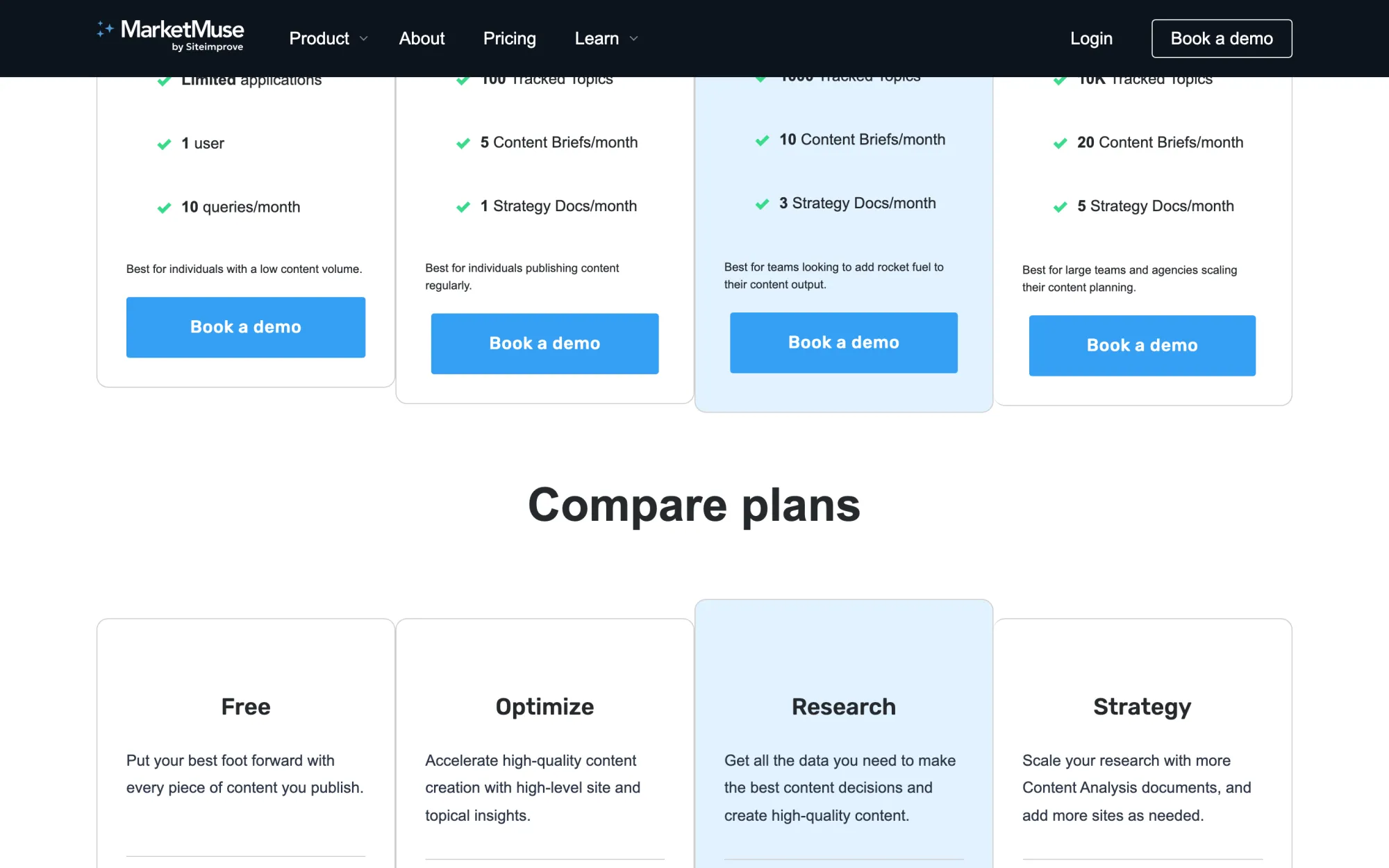
Rank.ai publishes the numbers on /pricing: $0 for Basic with no card, $50 for Starter, $250 for Pro. You can test the machinery before creating an account at all: the free tools run an AI visibility check, a 3x3 geo-grid scan, an AI Overview checker, a schema validator and more, with no signup. The distance from curiosity to working product is a checkout form here and a sales calendar there.
07
The full ledger
Every MarketMuse cell was verified against their live pricing page, rendered in a browser, and their per-product pages. Where we are behind, the ledger says so.
| Capability | Rank.ai | MarketMuse |
|---|---|---|
| Tracking | ||
| AI rank tracking (ChatGPT, Claude, Gemini + 4 more) | Yes | No |
| Public daily boards with recorded answers | Yes | No |
| Local rank tracking (geo-grid, Google Maps, Apple Maps) | Yes | No |
| Citations monitoring (directories) | Yes | No |
| Content | ||
| Content strategy + topic modeling | Partial | Yes |
| AI-generated content briefs | Yes | Yes |
| Live content scoring (page vs SERP) | Partial | Yes |
| Site-wide content inventory + decay monitoring | No | Yes |
| Full article drafts written for you | Yes | No |
| CMS publishing | WordPress, Webflow, Shopify, WordPress.com | Exports to Word / Docs |
| Peer-to-peer backlink exchange | Yes | No |
| Platform | ||
| MCP server for AI assistants | Pro plan | No |
| Public API | In roadmap | No public docs |
| Free tools without signup | Yes | No |
| Embeddable AI visibility widget | Yes | No |
| Published prices + online checkout | $0 to $250/mo self-serve | Demo call required |
Sources: marketmuse.com/pricing/ rendered in a browser August 2026; marketmuse.com /optimize/, /content-briefs/, /inventory/, /content-planning/ verified May 2026. Rank.ai cells sourced from backend code and rank.ai/pricing.
08
Frequently asked
What is the core difference between Rank.ai and MarketMuse?
Does MarketMuse track AI assistants like ChatGPT or Claude?
Is MarketMuse deeper on content strategy?
How does MarketMuse's pricing work compared to yours?
Do you have an API?
MarketMuse gives me briefs. What does Rank.ai give me?
Can I try Rank.ai without talking to anyone?
See your AI rankings today
The free plan records what the AI engines answer about your market, publishes 10 articles a month to your site and costs $0 with no card. No demo call on any plan you can buy online.