Compared
Rank.ai vs LocalFalcon
LocalFalcon is the geo-grid incumbent. Rank.ai runs the same geo-grid scans, tracks your brand across seven AI engines including Claude, and writes and publishes the content that closes the gaps the scans find. This guide walks both products screen by screen, with prices from their live pricing page and ours.
01
The short answer
LocalFalcon’s scans are the reference point for geo-grid rank tracking, and every scan ends with a diagnosis: these grid cells are weak, these AI answers skip you, these pages are missing. Rank.ai runs the same geo-grid measurement, tracks answers across seven AI engines including Claude, and then writes and publishes the missing pages into your CMS with your approval. One login carries the program from measurement to published fix.
Choose Rank.ai when
- The pages your rankings depend on should ship from the same login as the tracking
- Claude is one of the engines you need on the record
- You want purchased credits that keep their value month to month
- You want to inspect the vendor's measurement in public first
Choose LocalFalcon when
- Apple Maps geo-grids are a hard requirement today
- Your embedded scan widget must capture lead contact details
- Looker Studio or Zapier reporting is wired into your agency stack
- You need white label reports this month (their Premium tier)
Shopping a wider field? See our Local Falcon alternatives and pricing breakdown for six geo-grid trackers compared.
02
What each platform does
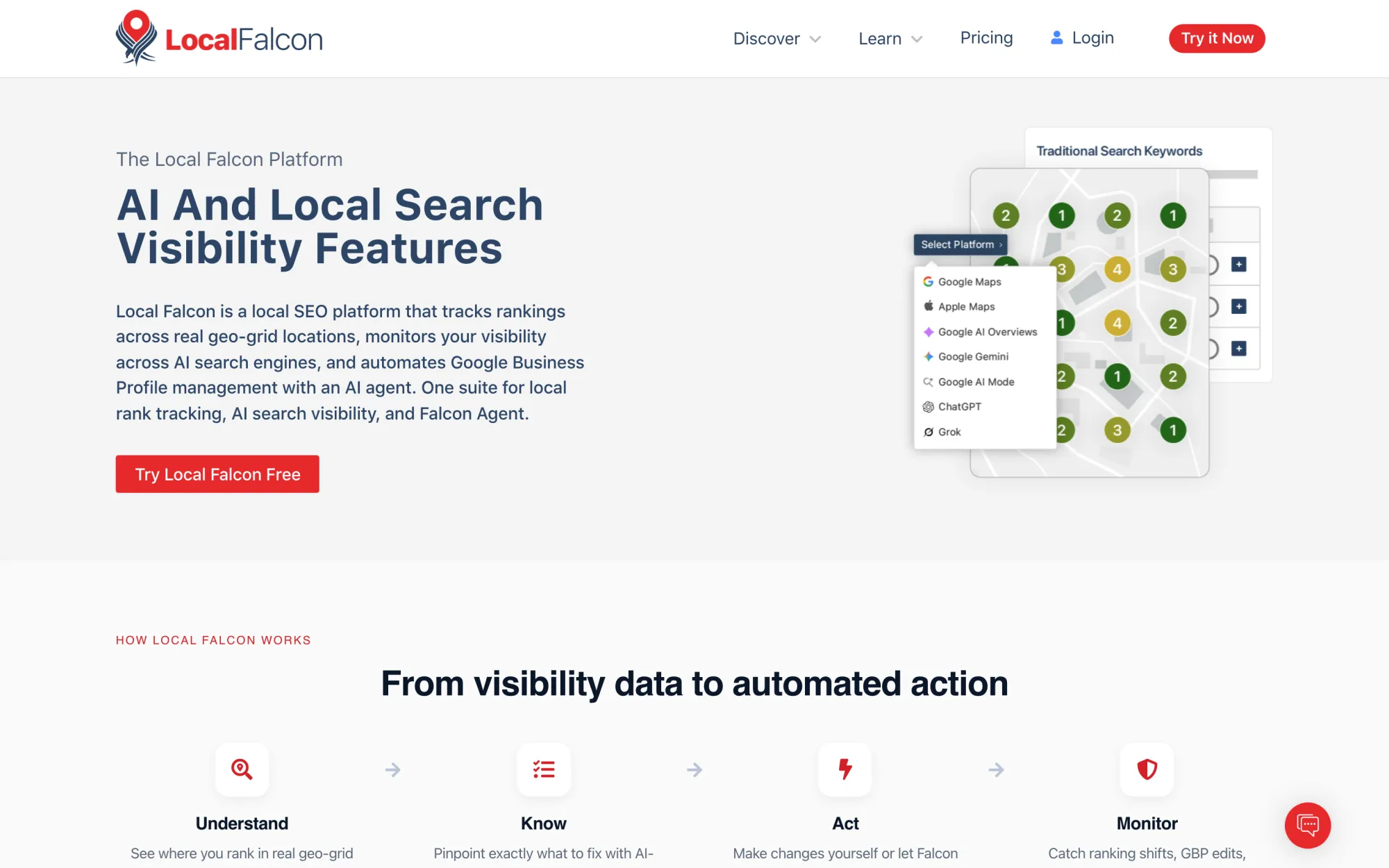
LocalFalcon is a local SEO platform built around the geo-grid scan: it tracks map rankings across real grid locations on Google and Apple Maps, monitors AI search visibility across its eight-platform lineup, and automates Google Business Profile work with Falcon Agent, which replies to reviews and schedules posts. It is a mature measurement and monitoring suite.
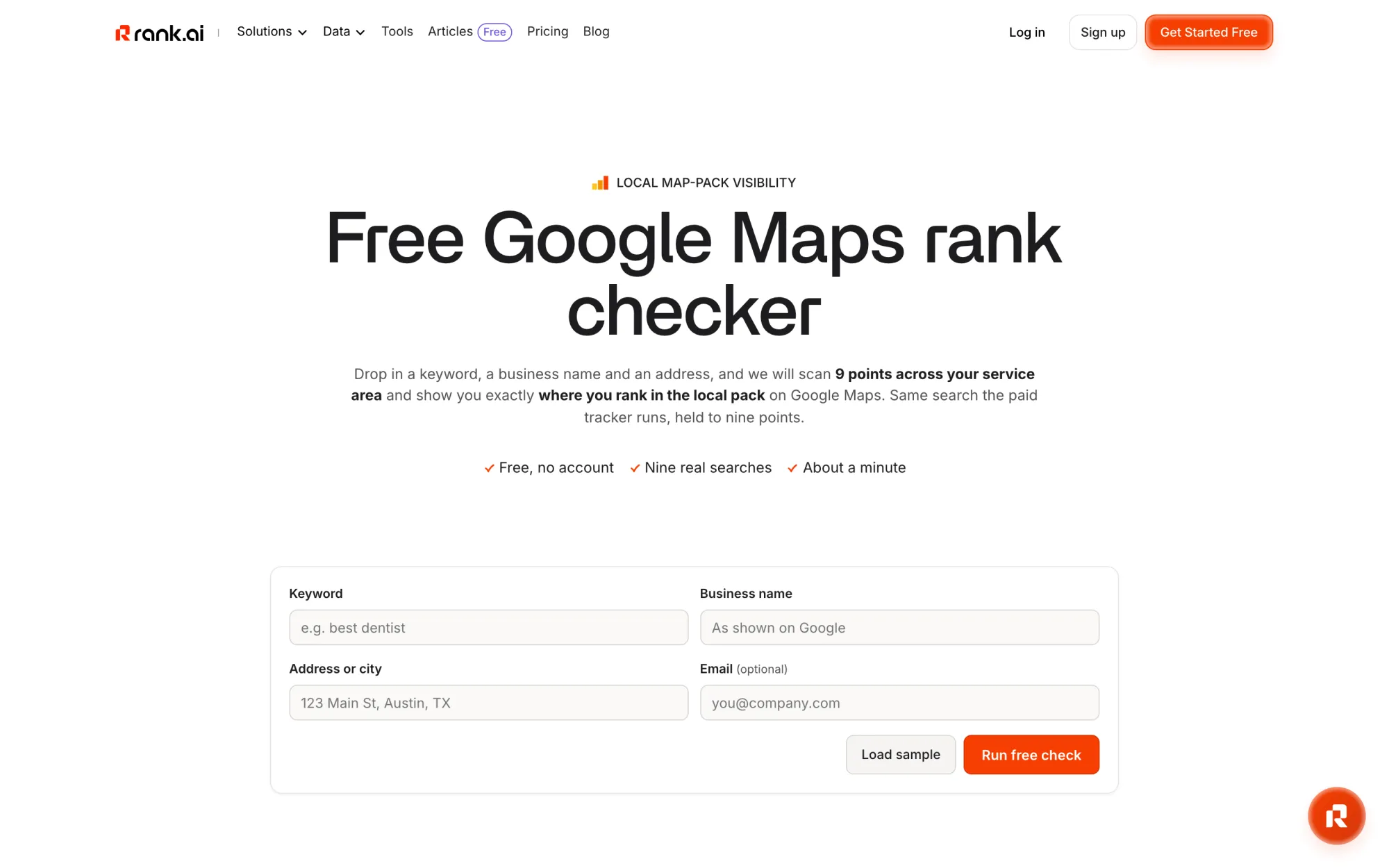
Rank.ai runs the same geo-grid measurement on Google Maps and treats it as the first half of a loop. The second half is production: recorded AI answers keep the URLs each engine cited, the citation gaps feed article briefs, and the article pipeline researches, writes and publishes into Webflow, WordPress, Shopify or WordPress.com with your approval. The free geo-grid scan runs the same search the paid tracker uses, on any business, with no account.
03
The Claude gap
LocalFalcon’s features page lists eight tracked AI platforms: ChatGPT, Gemini, Perplexity, Grok, AI Mode, Apple Intelligence, Copilot and Google AI Overviews. Claude is absent from that lineup. Their integrations section does show a Claude Connector, and that tool pipes LocalFalcon data into Claude for you to query; recording what Claude answers your buyers is a different job, and no LocalFalcon feature does it.
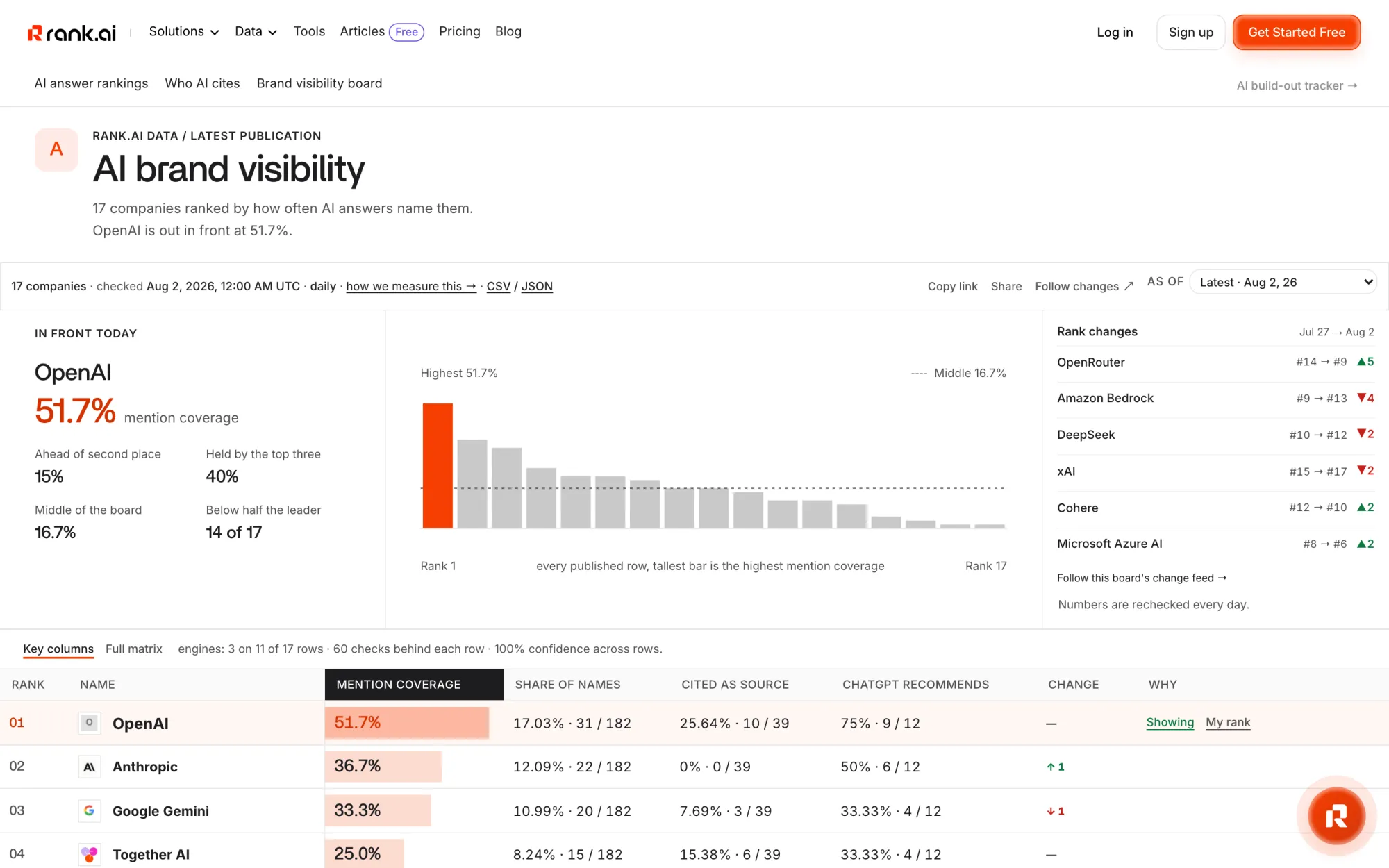
Rank.ai puts your market’s real buying questions to ChatGPT, Claude and Gemini every day, samples each engine three times to smooth out random variation, and records every brand each answer names along with the URLs it cited. Perplexity, Grok, Google AI Overviews and DeepSeek run on the same surface. When a prospect asks Claude who to hire, you have the receipt.
04
Articles written and published from the gaps your scans find
Every rank report ends the same way: a page needs to exist and someone has to write it. Rank.ai ships that step. You approve a brief, the pipeline researches the topic against live search results and the pages already ranking, writes the article through an editorial review loop, generates the images, and publishes into Webflow, WordPress, Shopify or WordPress.com. Nothing goes live without your approval, and the free plan includes ten published articles a month.
On LocalFalcon’s features page, content stops at review replies and Google Business Profile posts, so the pages your rankings depend on still come from your own writers. Each recorded Rank.ai answer keeps the URLs the engine cited, which shows which competitors own the pages the answers are built from and which questions cite nobody at all. That source list feeds the article brief directly, so the tracker and the writer run on the same data. On a standalone tracker that translation step is a person reading dashboards.
05
Credits and pricing in practice
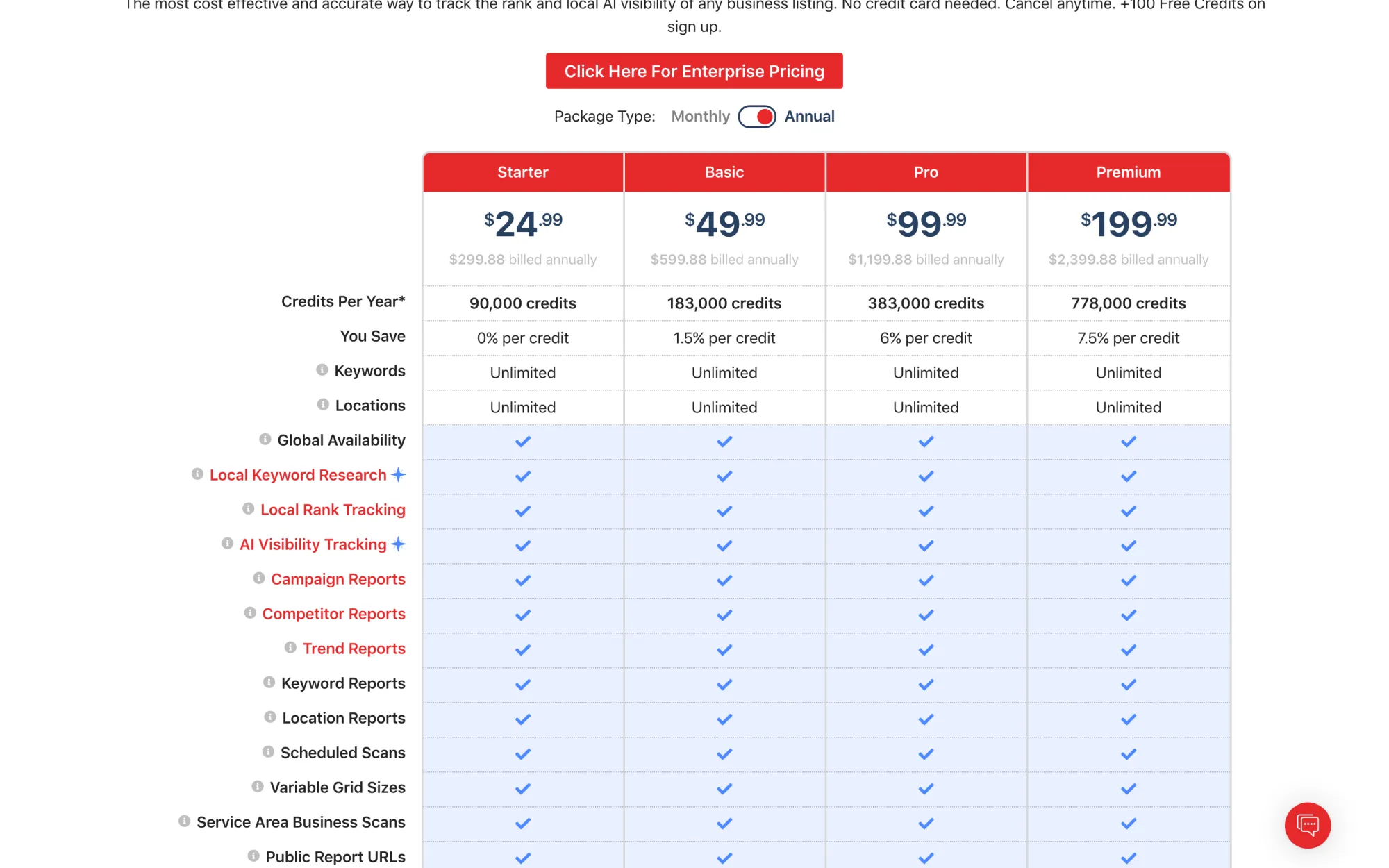
Both platforms meter scans in credits, and in both a credit is one map pin on a geo-grid. LocalFalcon’s annual packages run Starter $24.99, Basic $49.99, Pro $99.99 and Premium $199.99 a month, billed at $299.88 to $2,399.88 a year, with credit allotments from 90,000 to 778,000 a year and unlimited keywords and locations on every tier. White Label Reports tick only on Premium. Their pricing footnote says unused credit allotments expire at the end of each billing cycle.
Rank.ai Basic is $0 a month with no card: ten published articles a month, three Google keywords tracked daily and 500 credits for scans and audits. Paid plans are $50 and $250, and every plan draws from one pool at half a cent per credit. The pool is the point. One grid point costs one credit, so a daily 5x5 scan on three keywords runs 2,250 credits a month, about $11.25, and the same pool pays for Google rank checks, AI answer runs at 8 credits per question per engine, audits and overflow articles. Top-up credits you buy never expire, so a quiet month keeps its value for the busy one.
06
The full ledger
Every LocalFalcon cell below is grounded in their features or pricing page, rendered in a browser. Where Rank.ai is behind, the cell says so.
| Capability | Rank.ai | LocalFalcon |
|---|---|---|
| Rank tracking | ||
| Geo-grid rank tracking | Yes | Yes |
| Google Maps coverage | Yes | Yes |
| Apple Maps coverage | In roadmap | Yes |
| ChatGPT + Gemini answer tracking | Yes | Yes |
| Claude answer tracking | Yes | No |
| Perplexity tracking | Yes | Yes |
| Google AI Overviews tracking | Yes | Yes |
| Monitoring + reporting | ||
| GBP change monitoring | Yes | Yes |
| Embeddable scan widget | Yes | Yes |
| Lead capture on the embed | No | Yes |
| White label reports | In roadmap | Premium tier |
| Looker Studio + Zapier integrations | In roadmap | Yes |
| MCP server | Yes | Yes |
| Content + evidence | ||
| Article generation + CMS publishing | Yes | No |
| Peer-to-peer backlink exchange | Yes | No |
| Public daily boards of recorded AI answers | Yes | No |
| Free no-signup scan | Yes | No |
Sources: localfalcon.com/features and localfalcon.com/pricing, rendered in a browser August 2026.
07
Switching without losing your reporting
Migration is a re-setup: enter your locations and target keywords in Rank.ai and tracking starts the same day. We do not import LocalFalcon’s historical scan data, so most teams run the two side by side for a billing cycle, keep client reports on the old history while the new record builds, and consolidate once the Rank.ai record covers a full month. Geo-grid results carry a public share link from day one: mint a token and your client opens the live report with no login; revoke it and the link dies. A daily snapshot job also diffs every linked Google Business Profile and raises a change event when a category, hours block, photo or description shifts without you.
08
Frequently asked
Why would I choose Rank.ai over LocalFalcon for local SEO?
Does Rank.ai do everything LocalFalcon does?
Can I use both?
Do you track Apple Maps?
What is your pricing model, and how does it compare to LocalFalcon's credits?
Do you have white label reports?
What about content? LocalFalcon doesn't write articles, right?
How can I verify Rank.ai's AI tracking before paying?
How do I migrate my LocalFalcon scans to Rank.ai?
One login from scan to published article
Start on the $0 plan, run a free geo-grid scan, and watch the article pipeline publish to your own CMS.