
Alternatives
Local Falcon alternatives for geo-grid rank tracking
Local Falcon charges a credit for every map pin, from $24.99 a month billed annually. Here is what that costs in practice, and five trackers teams compare it with, on price, grid size, AI answers and content.
Pricing
Local Falcon pricing, explained with real scan math
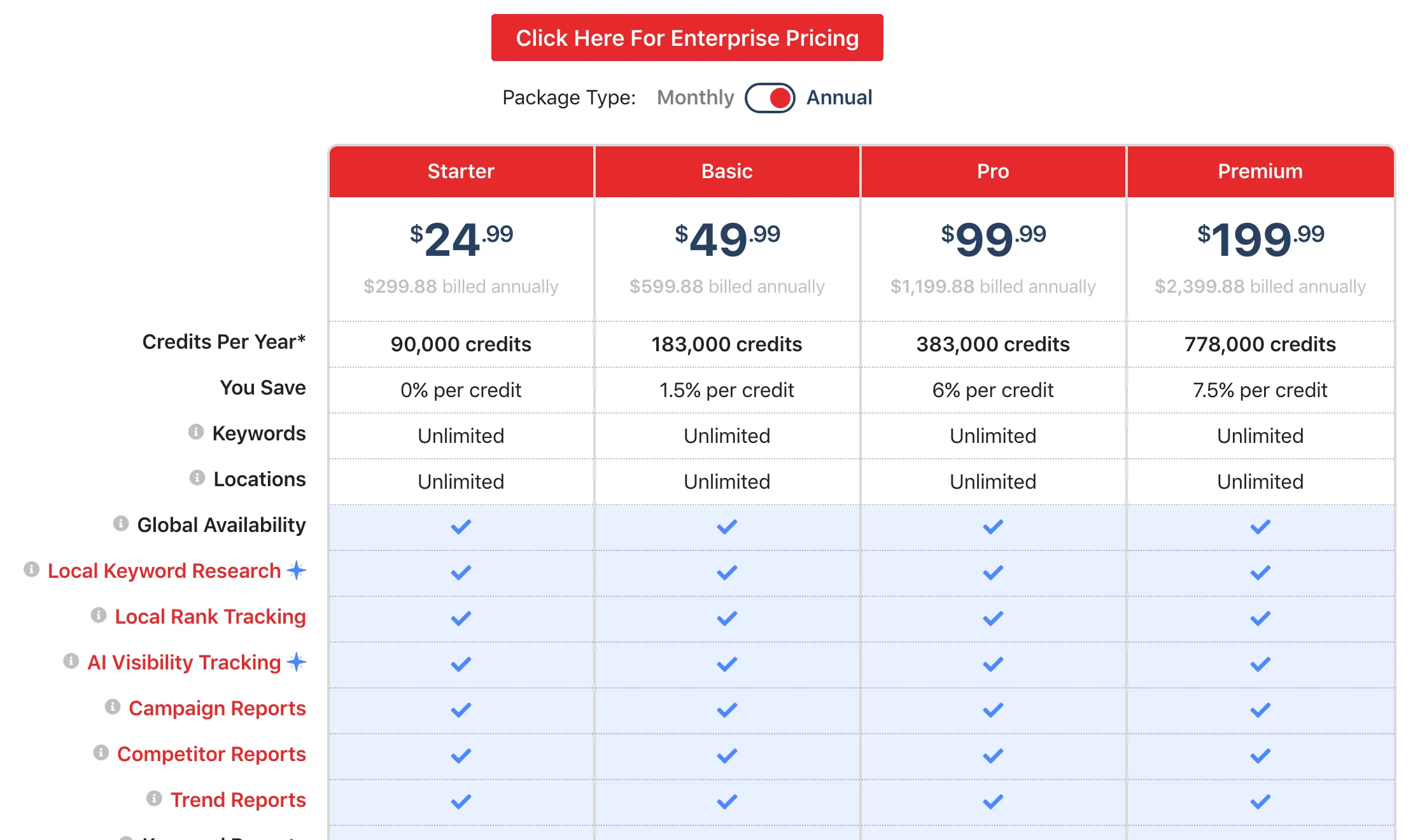
Local Falcon sells credits, and one credit is one map pin. A 5x5 grid uses 25 credits and a 15x15 uses 225, for each keyword, every time it runs. Starter, at $24.99 a month billed annually, comes with 90,000 credits a year; Premium, at $199.99, with 778,000. Keywords and locations are unlimited on every plan.
Tracking 5 keywords on a 15x15 grid once a week uses about 4,500 credits a month, so grid size and scan frequency decide the plan you need. Enterprise plans run from $499 to $4,999 a month, and pay as you go credits cost $0.05 each and never expire.
Side by side
Local Falcon and five alternatives, on price, grids, AI and content
Each fact about another company links to the page it was read from.
| Tracker | Price | Map grid | AI answers | Articles | Try it free |
|---|---|---|---|---|---|
| Local Falcon | $24.99 to $199.99 a monthBilled annually, in credits; Enterprise to $4,999localfalcon.com/enterprise-pricing | 3x3 to 21x21Google Maps and Apple Mapslocalfalcon.com/features/local-rank-tracking | 5 platformsChatGPT, Gemini, AI Overviews, AI Mode, Groklocalfalcon.com/llms.txt | NoNo CMS among its integrationslocalfalcon.com/integrations | 100 free creditsNo cardlocalfalcon.com/pricing |
| Rank.ai | $0, $49, $129 or $399 a monthPublished on rank.ai/pricing | 3x3, 5x5 or 7x7Google Maps, the Local Pack and organic results | ChatGPT, Claude, GeminiEvery day, from $49 a month | YesArticles published to WordPress, Webflow or Shopify | Free 3x3 map scanNo signup |
| BrightLocal | $31 to $49 a monthPer location, billed annuallybrightlocal.com/pricing | Local Search GridUp to five keywords on Trackbrightlocal.com/pricing | ChatGPT, AI Mode, AI OverviewsLocal AI Visibility Trackerbrightlocal.com/local-seo-tools/local-ai-visibility | Managed service$1,299 a monthbrightlocal.com/local-seo-services | 14 day trialNo cardbrightlocal.com/pricing |
| LocalOptics (Local Viking) | $39 to $200 a monthBy listings, from 1 to 70app.localoptics.com/pricing | YesGeoGrid credits on every planapp.localoptics.com/pricing | NoNone on its pricing pageapp.localoptics.com/pricing | NoGoogle Business Profile posts and reviewslocalviking.com | Not statedIts pricing page lists paid plans |
| Local Dominator | $33 to $164 a monthBilled annually; $39 to $197 monthlylocaldominator.co/pricing | YesGeo Grid on every plan, from 5,000 credits a monthlocaldominator.co/pricing | AI TrackerOn every planlocaldominator.co/pricing | NoListings and review tools, no articles listedlocaldominator.co/pricing | Free trialNo credit cardlocaldominator.co/pricing |
| Whitespark | Grids from $10 a monthEach tool sold on its ownwhitespark.ca/pricing | 4 to 225 pointsLocal Ranking Gridswhitespark.ca/local-ranking-grids | NoNone among its toolswhitespark.ca/pricing | In its $1,999 SEO serviceWordPress sites onlywhitespark.ca/seo-services | 200 free grid creditsNo cardwhitespark.ca/local-ranking-grids |
Facts about other companies were read on their own pages on September 27, 2026; each links to its source.
Sources, read September 27, 2026: localfalcon.com/pricing, localfalcon.com/enterprise-pricing, localfalcon.com/features/local-rank-tracking, localfalcon.com/llms.txt, localfalcon.com/integrations, localfalcon.com/about, brightlocal.com/pricing, brightlocal.com/local-seo-tools/local-ai-visibility, brightlocal.com/local-seo-services, app.localoptics.com/pricing, localviking.com, localdominator.co/pricing, whitespark.ca/pricing, whitespark.ca/local-ranking-grids, whitespark.ca/seo-services.
The alternatives
Five trackers to weigh against Local Falcon
What each one does best, from its own pages.
01Rank.ai
Map scans, AI answers and the pages that fix them, on one plan
The map scan checks your Google Maps rank from a 3x3, 5x5 or 7x7 grid of points around each location, whenever you run it. From $49 a month it also asks ChatGPT, Claude and Gemini your buying questions every day, and it writes and publishes the articles for the questions you are missing from.
Rank.ai vs Local Falconmed spa near me
Rejuvenate Austin at the center, 7×7 grid
- Best rank
- 2
- Average
- 8.4
- Top 3
- 1 of 49
- Top 10
- 15 of 49
- Top 20
- 20 of 49
Scan recorded Sep 25, 2026
02BrightLocal
The local SEO suite, now with ChatGPT and Google AI tracking
From $31 a month per location, billed annually, BrightLocal pairs local rank tracking and a map grid for five keywords with listings, citations and reviews, and its Local AI Visibility Tracker checks ChatGPT, Google AI Mode and Google AI Overviews.
Rank.ai vs BrightLocal03LocalOptics
Profile management with map grids, priced by listing
Local Viking’s pricing now opens on LocalOptics: $39 a month for one Google Business Profile up to $200 for 70, each with GeoGrid credits, post scheduling and review management. White label reporting starts on the $99 plan.
04Local Dominator
Credits for grids, AI tracking and listings from $33 a month
Local Dominator puts an AI tracker, geo grid and SERP tracking on every plan, from $33 a month billed annually for 5,000 credits. Its Pro and Powerhouse plans roll unused credits over for two months and add an API and white label.
05Whitespark
The largest grids here, sold tool by tool
Whitespark’s Local Ranking Grids scan from 4 to 225 points on credits from $10 a month, and its rank tracker, citation tools and review platform are each priced on their own. None of them tracks AI answers.
Rank.ai vs WhitesparkFrequently asked
How does Local Falcon pricing work?
Is there a free Local Falcon alternative?
What is a geo-grid scan?
Does Rank.ai track AI answers as well as map rankings?
Which alternative has the largest grids?
When is Local Falcon still the right pick?
See if AI names you when customers ask who’s best.
Enter your website. In about two minutes, Rank.ai asks ChatGPT, Claude and Gemini 12 questions your customers ask and grades how often they name you.
- Your grade out of 100How often AI names you, cites your site, and how high it ranks you.
- Who gets namedEvery competitor in the answers, most named first.
- The pages AI readsThe sources behind each answer.
- Three fixesWhat to fix first, with a brief for the first page.