Compared
Rank.ai vs Otterly
Otterly monitors AI search on four engines and sells the rest as add-ons. Rank.ai includes all seven engines, tracks Google and local rankings beside them, and publishes the articles that close the gaps. This guide walks both products screen by screen, with prices from their live pricing page and ours.
01
The short answer
Otterly is a credible AI search monitor: a Gartner Cool Vendor for AI in Marketing in 2025, trusted by 30,000+ marketing professionals by its own count, with transparent pricing and Copilot coverage in its base tiers. Its shape is monitoring plus advice. Four engines come with the plan, Claude costs up to $439 a month extra, Gemini and AI Mode are paid add-ons, and the output of its optimization tools is an audit and a recommendation list. Rank.ai includes all seven of its engines in every paid plan with no add-on fees, tracks your Google and local rankings on the same login, and converts its own findings into long-form articles it writes, illustrates and publishes into your CMS, 10 a month on the $0 plan.
Choose Rank.ai when
- Claude, Gemini, Grok and DeepSeek belong in the price, without add-on line items
- Google and local rankings should sit beside the AI data
- Recommendations should end as published pages, with your approval gate
- You want a $0 plan that keeps working after the trial window
Choose Otterly when
- Microsoft Copilot coverage in the base plan is a requirement
- A metered REST API today outweighs a roadmap one
- ChatGPT Ads and Shopping tracking matter to your program
- You want the audit and recommendation workflow alone
02
What each platform does
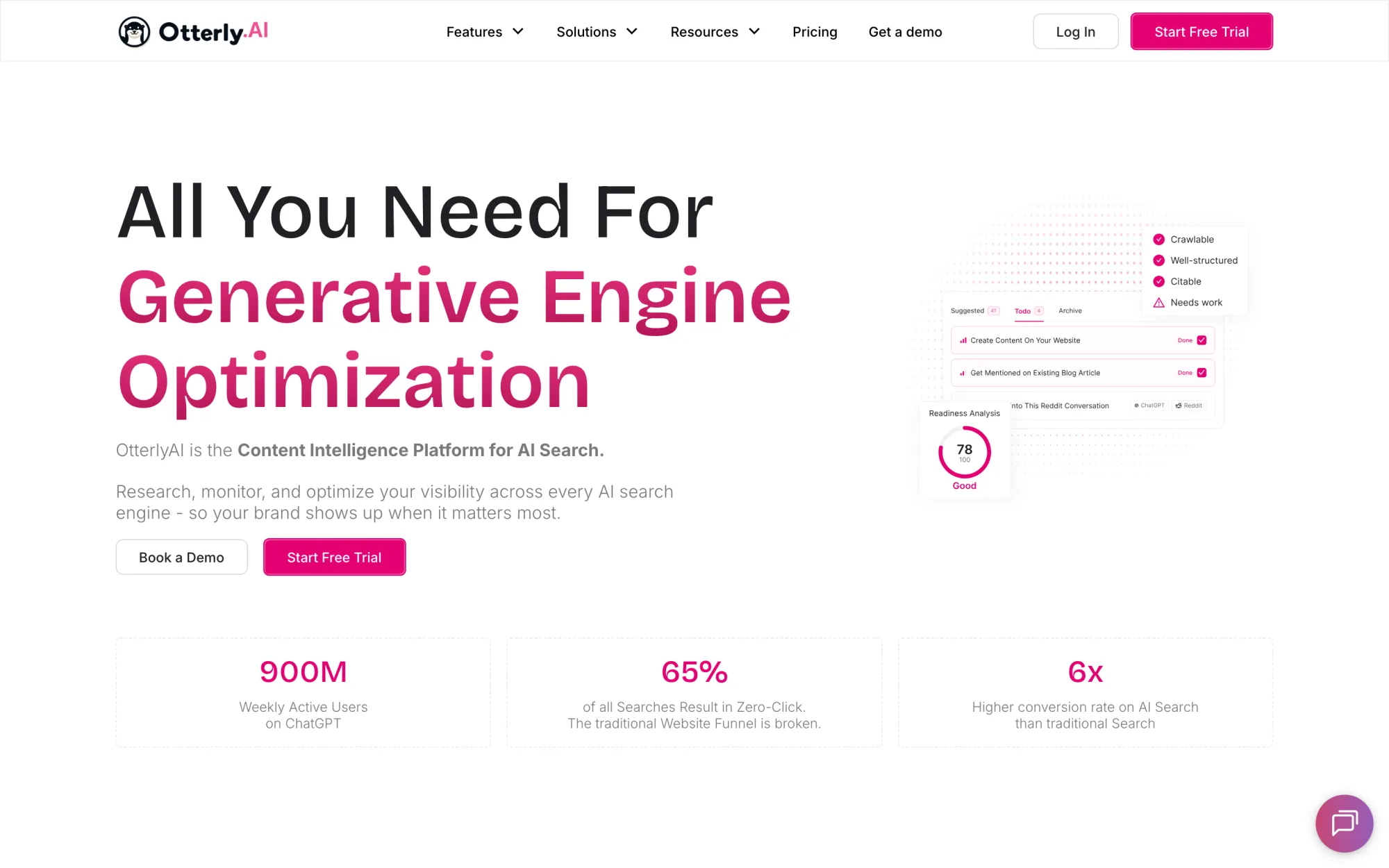
Otterly is AI search monitoring and optimization: brand mentions, sentiment and citations tracked daily, a crawlability checker and content audit for AI readiness, prompt research, and weekly domain citation tracking. Its output is data and a recommendation list your team acts on.
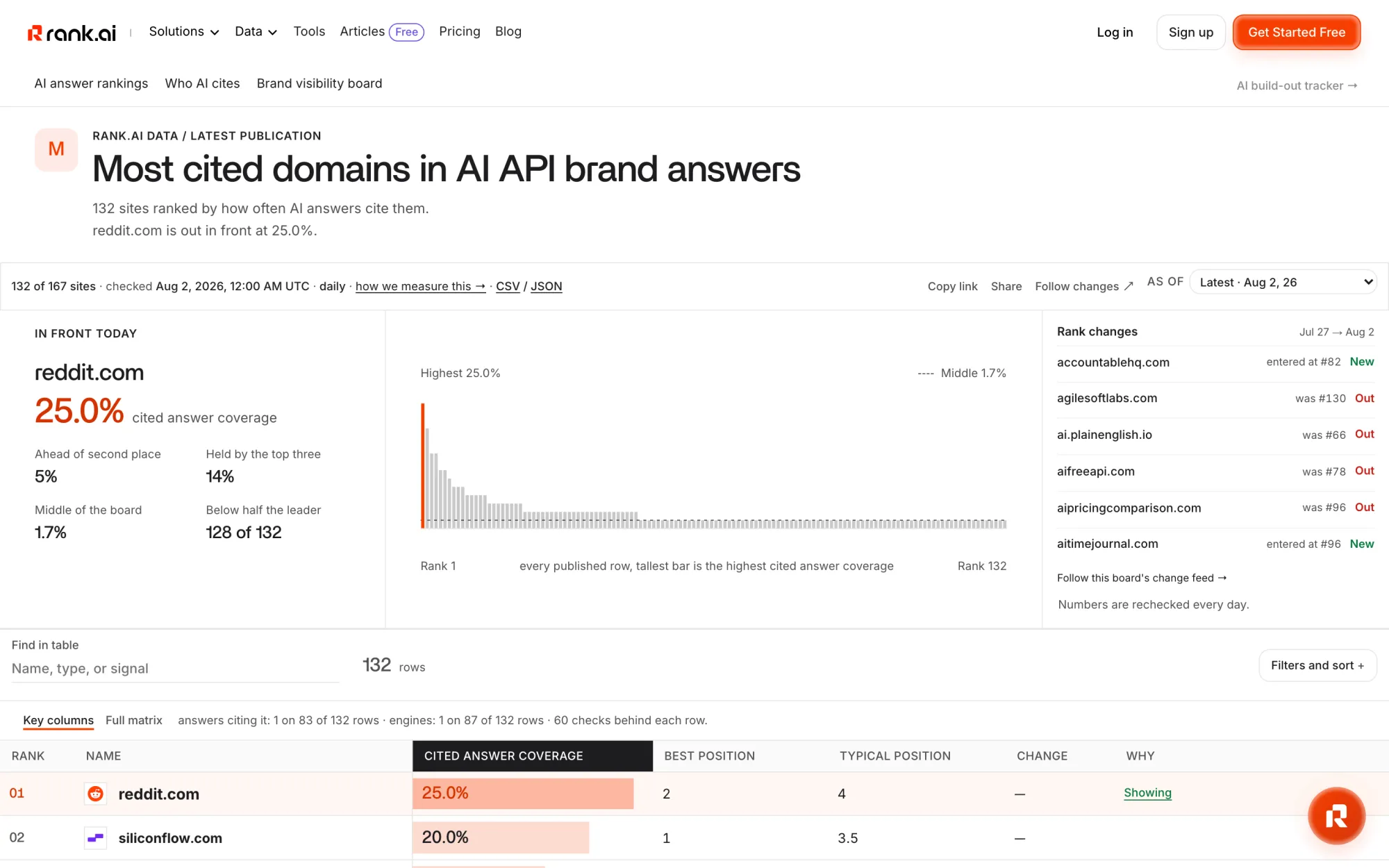
Rank.ai runs the same class of daily measurement across seven engines, adds Google and local rank tracking on the same login, and converts findings into published pages through the article pipeline. The measurement itself is public on the daily boards, recorded answer by recorded answer, before you ever sign up.
03
The add-on math
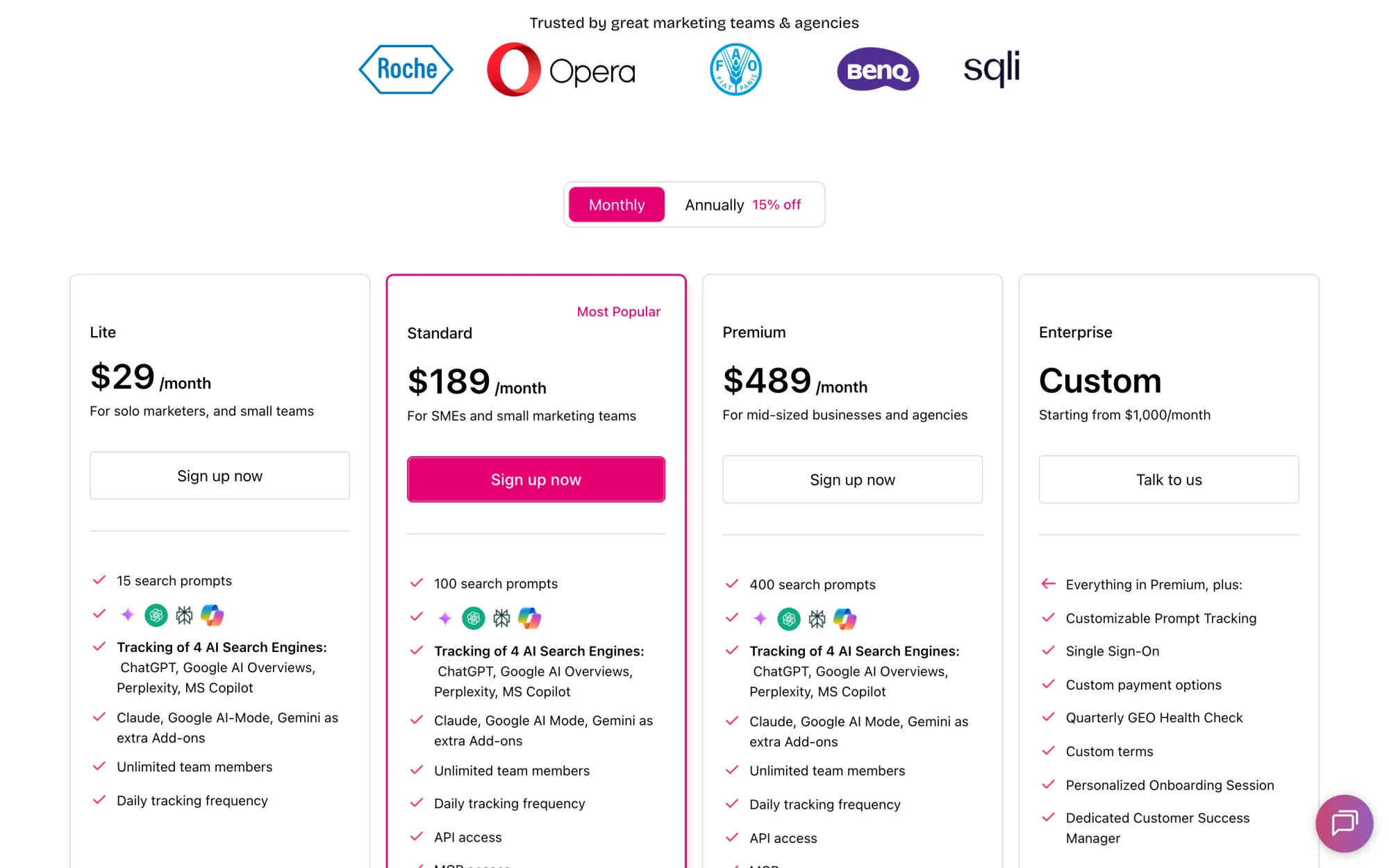
Otterly’s pricing turns engine coverage into line items. The cards read Lite $29, Standard $189 and Premium $489 a month, each including “Tracking of 4 AI Search Engines: ChatGPT, Google AI Overviews, Perplexity, MS Copilot” with “Claude, Google AI-Mode, Gemini as extra Add-ons.” Claude runs $29 to $439 a month by tier, and Gemini and AI Mode each run $9 to $149. A Standard customer who wants Claude and Gemini pays $357 a month before adding a prompt.
On Rank.ai, every question runs on ChatGPT, Claude, Gemini, Perplexity, Grok, Google AI Overviews and DeepSeek daily, three samples per engine, on every paid plan. Grok and DeepSeek appear on neither of Otterly’s lists; both are live providers here. You choose engines by where your buyers are, and the price never moves.
04
Every recorded answer is a work order
Each run stores the full answer text, the exact model version that produced it, whether your brand was named and how far into the answer it first appears, whether your site was cited and at what position in the source list, the complete ordered list of cited pages, and the searches the engine ran where it exposes them. The morning after a run, you open the answer that left you out, read the two or three pages it was built from, and commission the article for that gap from the same dashboard. The next day’s run tells you whether the fix landed.
05
Google, local and content on the same login
Otterly watches AI search. Rank.ai also checks your Google rankings daily on every plan, 3 keywords at $0 up to 100 on Pro, and the local suite scans a geo-grid around each location to map your Google Maps position street by street, with Local Pack tracking, GBP audits and review monitoring beside it. If Google still sends you most of your traffic, or your customers find you through a map pin, that half of your search presence needs a tracker too.
The content step is where the products diverge hardest. Otterly’s content tools audit a page, score its AI readiness and recommend changes, and the work then lands on your calendar. Rank.ai’s pipeline executes: it researches the topic against live search results and the pages already ranking, writes the long-form draft, generates the images, holds it in a review queue for your approval, and publishes into WordPress, Webflow or Shopify. You set the pace, themes and voice, a competitor blacklist keeps rival domains out of every link, and auto publish is one switch. Every plan includes the allowance: 10 articles a month free, 30 on Starter, 100 on Pro.
06
The full ledger
Every Otterly cell below is grounded in otterly.ai, /pricing or /features, rendered in a browser; every Rank.ai cell is verified against our own code. Where we are behind, the cell says so.
| Capability | Rank.ai | Otterly |
|---|---|---|
| Engines | ||
| Engines included in the plan price | All 7, every paid plan | 4, add-ons for the rest |
| Claude tracking | Included | Add-on, $29 to $439/mo |
| Gemini tracking | Included | Add-on, $9 to $149/mo |
| Grok tracking | Yes | Not listed publicly |
| DeepSeek tracking | Yes | Not listed publicly |
| Microsoft Copilot tracking | No | Yes |
| Google AI Overviews tracking | Yes | Yes |
| Daily prompt tracking | Yes | Yes |
| Sentiment per brand mention | Yes | Yes |
| Citation tracking | Yes | Yes |
| Beyond AI answers | ||
| Google organic rank tracking | Yes | No |
| Local SEO (GBP, Maps, geo-grid) | Yes | No |
| Articles written + published to your CMS | Yes | No |
| Articles included in the monthly price | 10 to 100 a month | No |
| Data access + evidence | ||
| Public daily record of AI answers | Yes | No |
| Free tools without signup | Yes | 7-day free trial |
| MCP server | Pro plan | $189 plan and up, metered |
| Public API | In roadmap | $189 plan and up, metered |
| Looker Studio connector | Yes | $189 plan and up |
| CSV export | Yes | Yes |
| Entry price | $0, no card | $29/mo |
Sources: otterly.ai, otterly.ai/pricing, otterly.ai/features, rendered in a browser August 2026.
07
Frequently asked
What's the core difference between Rank.ai and Otterly?
What does Otterly cost once the add-ons are counted?
Do you track Microsoft Copilot or Google AI Mode like Otterly?
Does Otterly write articles or publish to my CMS?
Does Otterly do Google rank tracking or local SEO?
Otterly ships an API at $189. What do you offer?
Otterly starts at $29 a month. What does Rank.ai cost?
Can I use both?
The free plan publishes 10 articles a month
Connect your site, see your rankings across seven AI engines and Google, and judge the output on your own domain before you spend anything.