Compared
Yext vs Writesonic
Yext is a digital presence platform; Writesonic is a GEO + content platform. This guide compares the two in depth, engine coverage, tracking mechanics, content production, SEO and local surfaces, data access and full pricing tiers, using only facts read from their live pages.
01
The short answer
Yext is the enterprise platform for managing business data: a Knowledge Graph as source of truth, Listings syndication, Reviews, Pages, and Scout as its listed AI search product. Writesonic pairs AI visibility tracking with content execution: three platforms tracked daily on self-serve plans, an AI article writer publishing to WordPress, site audits with automatic fixes and an Action Center. They compete only where the categories overlap, and the chapters below walk every dimension a buyer would price: which AI engines each can see, how the tracking actually meters, what each produces on the content side, what surrounds the core product, and the full published tier lists.
Choose Yext when
- Listings syndication for hundreds of locations
- Knowledge Graph as a single source of truth
- Industry solutions for finance, healthcare, retail
- Reviews and social tooling in one platform
Choose Writesonic when
- Site audits at scale with automatic AI fixes
- Action Center executes on-page and off-page fixes
- Ads monitoring inside AI answers
- SOC 2 Type II, GDPR and HIPAA options
02
What Yext is
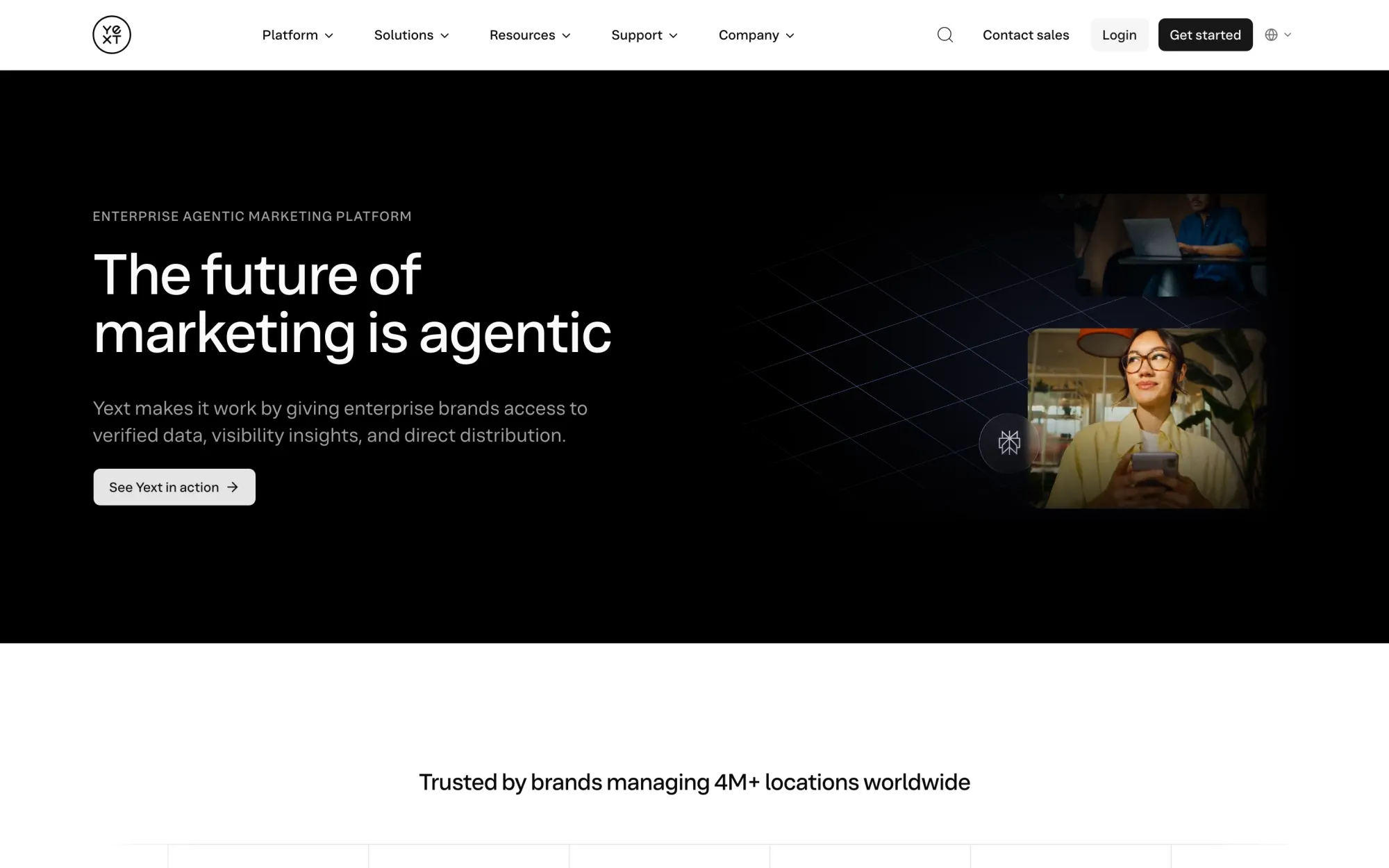
Yext built the category for managed business data at enterprise scale. Its platform navigation lists Scout, Listings, Knowledge Graph, Reviews, Social, Pages, Search, Hearsay Social, Hearsay Relate and Yext AI, with industry solutions for financial services, healthcare, retail, food and hospitality. The model: the Knowledge Graph holds the verified facts about every location, Listings syndicates them everywhere that matters, Pages hosts location landing pages, and Reviews and social tools manage the conversation around them.
Pricing model. Demo-led; yext.com/pricing returned a page-not-found when rendered, so no dollar figure is claimable from their public site.
| Yext plan | Price | What the page says |
|---|---|---|
| Platform | No price published | /pricing 404s; every CTA is Get a Demo |
Tier facts rendered from yext.com, August 2026.
03
What Writesonic is
Writesonic is a GEO and content platform used by 10,000+ marketing teams by its own count, carrying SOC 2 Type II, GDPR and HIPAA compliance badges. The loop it sells: track your brand across AI platforms daily, find the prompts recommending competitors, then fix visibility gaps with AI articles, technical site audits with automatic fixes, an Action Center executing on-page and off-page changes, and agentic workflows. Ads monitoring inside ChatGPT and Google AI answers and AI search volume estimation round out the research side.
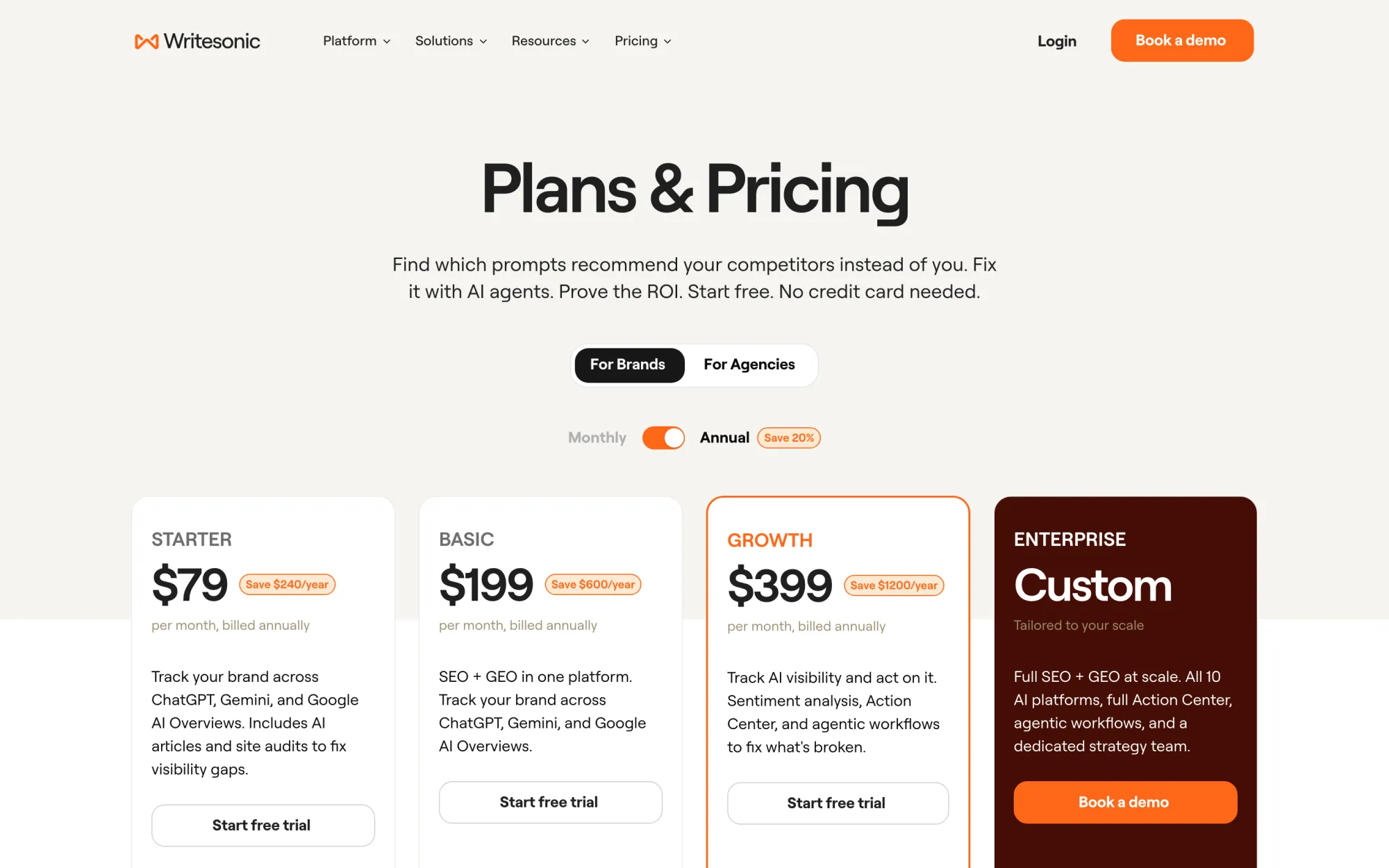
Pricing model. Starter $79, Basic $199 and Growth $399 a month on annual billing (20% more monthly), all tracking ChatGPT, Gemini and Google AI Overviews with 15 to 50 articles included; Enterprise is custom with all ten platforms and the full Action Center.
| Writesonic plan | Price | What the page says |
|---|---|---|
| Starter | $79/mo | annual; 50 prompts, 3 platforms, 15 articles, 10 audits |
| Basic | $199/mo | 100 prompts, 300 answers daily, 25 articles, 20 audits |
| Growth | $399/mo | 200 prompts, 600 answers daily, 50 articles, sentiment, Action Center trial |
| Enterprise | Custom | all 10 platforms, full Action Center, Looker, SSO/SAML |
Tier facts rendered from writesonic.com/pricing, August 2026.
04
AI engine coverage
Yext. Scout appears in the platform navigation as Yext's AI search product; its engine list and tracking depth are not described on the rendered pages, so specifics need verification with their team. No named AI engines appear on the pages we rendered.
Writesonic. The platforms row reads the same on all three self-serve tiers: ChatGPT, Gemini and Google AI Overviews, in one market (language plus country). Enterprise reads all 10 platforms without enumerating them on the pricing page; Claude and Perplexity appear on no self-serve row.
Summarized: Yext reads scout listed; scope not described publicly; Writesonic reads 3 self-serve (ChatGPT, Gemini, AIO); all 10 on Enterprise. On Claude specifically, Yext: not stated; Writesonic: not on self-serve plans.
05
Tracking and measurement mechanics
Yext. The platform's discipline is data consistency across the ecosystem: syndicating verified facts from the Knowledge Graph to directories, search engines and maps. Position measurement in the rank-tracking sense appears nowhere on the rendered public pages.
Writesonic. Tracking is daily on every tier, with 50 to 200 prompts and 50 to 600 answers tracked per day by tier, plus prompt diversification. Sentiment analysis starts on the $399 Growth tier, and ads monitoring inside ChatGPT and Google AI ships across plans, with AI search volume and Brand Explorer as limited one-time runs on self-serve.
06
Content production
Yext. Pages is the content surface: location landing pages generated and hosted from Knowledge Graph data at scale, common in multi-hundred-location deployments. There is no long-form article product on the rendered pages.
Writesonic. The AI Article Writer includes 15, 25 and 50 articles a month by tier, with a $100-a-month add-on for 20 more on Growth, brand voice as 1 to 10 writing styles, content optimization, and a WordPress integration for publishing. Site audits run 10 to 50 a month covering 100 to 2,500 pages each, with automatic AI fixes, and agentic workflows meter as trial runs (10 to 100) on self-serve.
07
SEO and local coverage
Yext. Listings syndication for large location counts is the core: one source of truth pushed everywhere, with Reviews for monitoring and response and industry-specific solutions layered on. This is distribution infrastructure more than measurement tooling.
Writesonic. There is no Google organic rank tracker and no local surface: no Maps, geo-grid or GBP tooling on the pricing page. Google Search Console and GA4 integrate for search data, and Reddit plus Google Keyword Planner feed the data sources.
08
Data access, APIs and integrations
Yext. Platform APIs are documented (Point and Click, SDK, APIs per their documentation section) and the Knowledge Graph is the structured-data asset underlying everything. Evaluation runs through enterprise demos.
Writesonic. Integrations cover GSC, WordPress and GA4 on self-serve with Looker Studio on Enterprise; an MCP is listed in the footer navigation and API docs exist. SSO/SAML and user access control are Enterprise features, alongside dedicated Slack and Teams support.
09
The full ledger
Every cell below was read from the vendors’ own rendered pages as of August 2026. Where a vendor’s public pages neither confirm nor deny a capability, the cell says so.
| Dimension | Yext | Writesonic |
|---|---|---|
| AI engines | Scout listed; scope not described publicly | 3 self-serve (ChatGPT, Gemini, AIO); all 10 on Enterprise |
| Claude coverage | Not stated | Not on self-serve plans |
| Tracking cadence | Data sync, not position measurement | Daily |
| Google rank tracking | Not listed | None (GSC integration only) |
| Local / map tracking | Listings distribution at enterprise scale | None |
| Content output | Pages product (location landing pages) | 15 to 50 AI articles/mo + site audits |
| CMS publishing | Own Pages platform | WordPress |
| API / MCP | APIs documented for the platform | MCP listed; API docs; Looker on Enterprise |
| Entry price | Demo call; /pricing 404s | $79/mo (annual) |
Sources: yext.com (pricing URL 404s); writesonic.com/pricing. Rendered in a browser, August 2026.
10
Frequently asked
What is the core difference between Yext and Writesonic?
How does Yext's pricing compare to Writesonic's?
Which AI engines does each cover?
Who should pick Yext?
Who should pick Writesonic?
How does Rank.ai compare to Yext and Writesonic?
How each compares to Rank.ai
We keep our own product out of this comparison. If you want the same verified treatment with Rank.ai in the frame, the one-on-one guides for Yext and Writesonic carry it.