Compared
Rank.ai vs Writesonic
Both products track AI answers and publish articles, so this comparison is decided by specifics: which engines each can see, what each stores about an answer, where the articles can publish, and what surrounds the loop. Every number here is read from Writesonic's live pricing page and our shipped code.
01
The short answer
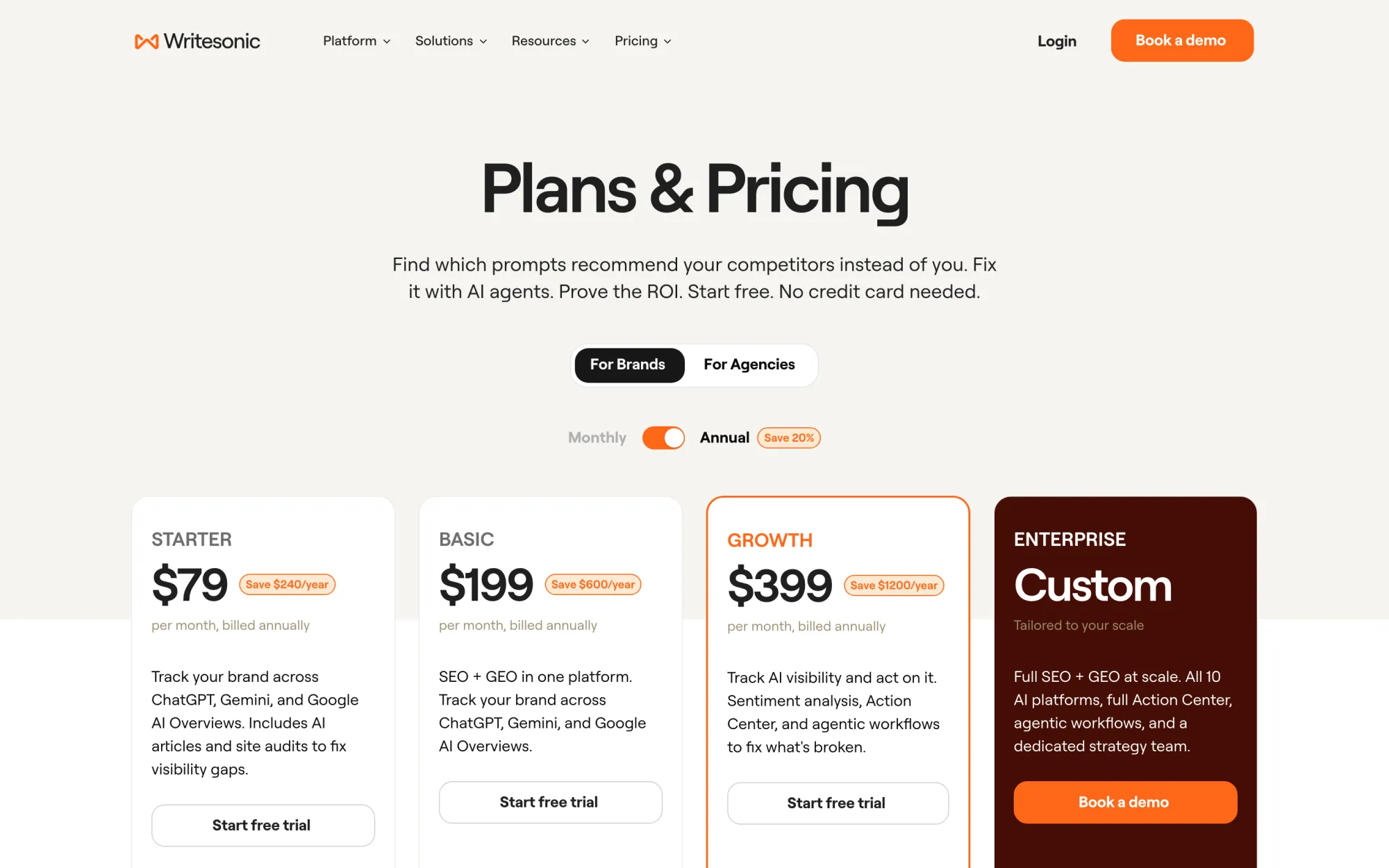
A buyer putting these two side by side is choosing between two versions of the same loop. On Writesonic’s self-serve plans the loop sees three platforms, ChatGPT, Gemini and Google AI Overviews, in one market, publishes to WordPress, and reports without sentiment until the $399 tier. On Rank.ai the loop sees seven engines including Claude, Perplexity, Grok and DeepSeek from the $50 plan, stores every answer down to the sentence and source, publishes to four CMSs, and runs beside daily Google rank checks and a geo-grid map tracker that have no Writesonic equivalent at any tier. The free plan publishes 10 articles a month, so the whole claim is testable on your own domain for $0.
Choose Rank.ai when
- Claude, Perplexity, Grok and DeepSeek answers must be on the record
- Google and map rankings belong in the same loop as the AI data
- You publish to Webflow, Shopify or WordPress.com, beyond WordPress
- 100 articles at $250 fits your calendar better than 25 at $199
Choose Writesonic when
- Automated site remediation at audit scale is the core job
- The ten-platform Enterprise lineup covers engines you require
- Ads monitoring inside AI answers is part of your program
- SOC 2 Type II and HIPAA are procurement requirements
02
Four engines their self-serve plans can't see
Writesonic’s compare table reads the same on all three self-serve tiers: ChatGPT, Gemini, Google AI Overviews, one market. Claude, Perplexity, Grok and DeepSeek do not appear on any self-serve row, and the ten-platform lineup arrives only with an Enterprise conversation.
What that means in practice: a buyer researching your category in Claude, a Perplexity answer citing your competitor’s comparison page, a Grok answer inside X, none of it reaches a Writesonic self-serve dashboard. On Rank.ai every tracked question runs against all seven engines every day, three samples per engine to smooth model randomness, from the $50 plan. When one engine flips who it recommends, the record shows which one, on which day, citing which page.
03
What a recorded answer holds
The depth of the record decides what you can do with it. Each Rank.ai run stores the full answer text; every brand mention with its exact character position, the sentence around it, a sentiment call on that specific mention, and the brand’s domain, so competitors you never listed still get identified; every citation with its URL, title, position and an attribution flag; and, for engines that search before answering, the Google queries the model actually issued, the closest thing that exists to a keyword list for AI answers. On Writesonic’s published plans, sentiment itself starts at $399.
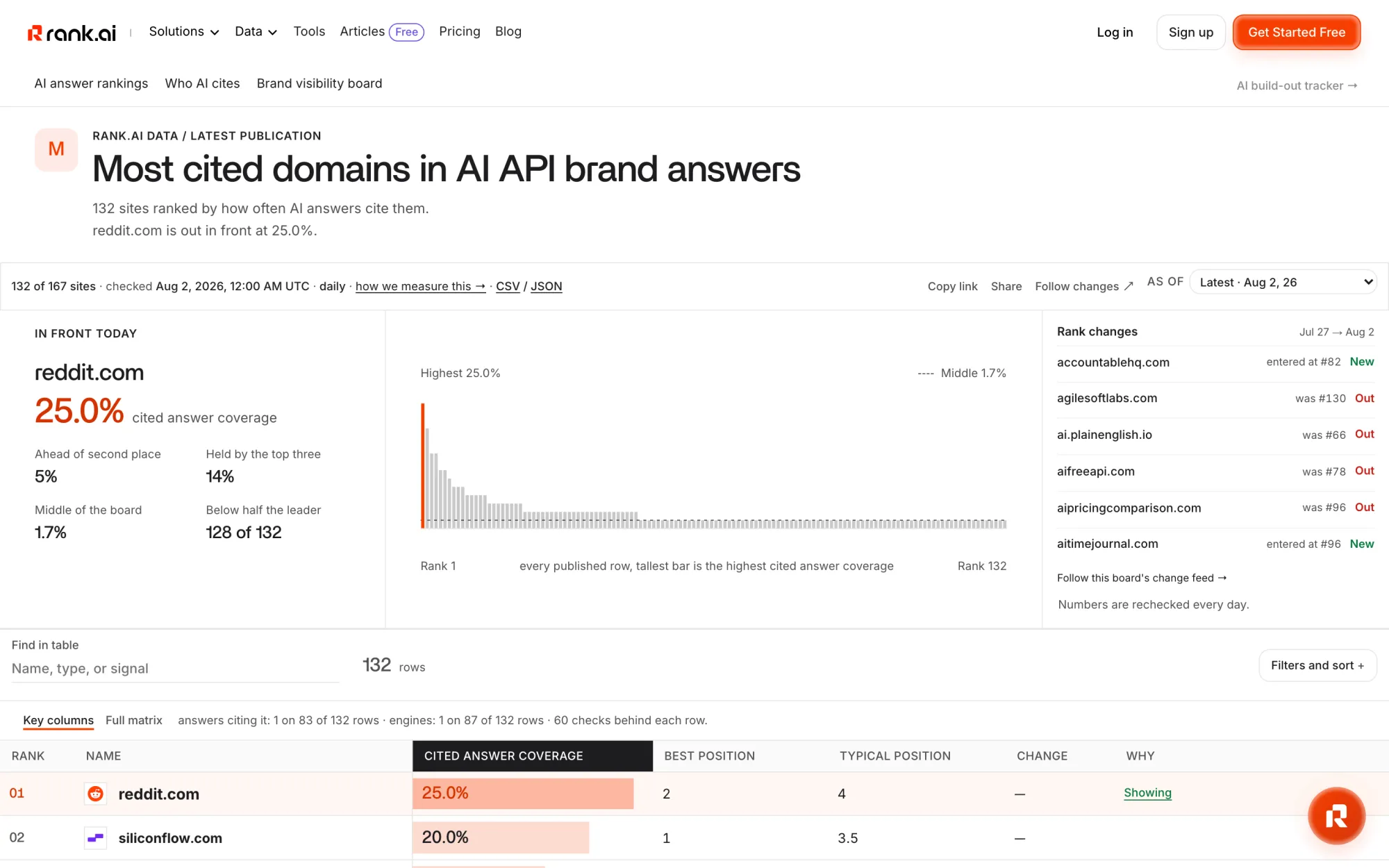
The record is also public. The daily boards publish recorded answers with sample sizes, evidence ledgers, permalink snapshots and CSV export, no account needed, so the measurement can be audited before a dollar moves.
04
Article for article
Both pipelines write and publish, so compare them at the unit level. A Rank.ai brief starts from the record: a question where the engines cite nobody, or cite a competitor. The research pass reads the live SERP and the pages already being cited. The draft comes out in your voice, learned from writing samples you paste in once, with images generated per section on your brand palette. A competitor-domain blacklist makes it impossible for any generated article to link to a rival, subdomains included, and a practitioner deny-list keeps your own people’s names from being hyperlinked anywhere you would not want. You approve by hand or set a weekly cadence and let it run. It publishes into WordPress, Webflow, Shopify or WordPress.com, and the next day’s run reports whether the answers started citing it.
The allowances: 10 articles a month at $0, 30 at $50, 100 at $250, against 15 at $79, 25 at $199 and 50 at $399 publishing to WordPress, with brand voice as 1 to 10 style slots by tier. At the two-hundred-dollar mark the gap is 100 articles against 25.
05
The rest of the channel, on the same login
AI answers are one surface of search. Rank.ai checks Google rankings daily on every plan, 3 keywords at $0 up to 100 on Pro, and the local tracker scans a geo-grid across each service area daily, recording your map-pack rank and every tracked competitor’s at each point, with GBP audits, weekly citation sweeps and review analysis beside it. Nothing on Writesonic’s pricing page tracks a Google position or a map pin. A GEO program that cannot see Google or the map is reporting on half the channel.
06
Price for price
At $79, Writesonic tracks three platforms and publishes 15 articles to WordPress. At $50, Rank.ai tracks seven engines, publishes 30 articles to four CMSs, checks 25 Google keywords daily and tracks one location’s geo-grid. At $199 against $250: 25 articles, three platforms and one market, against 100 articles, seven engines, 100 keywords, unlimited locations and the MCP server. Sentiment is included in every Rank.ai paid plan and starts at $399 at Writesonic. And the $0 plan is permanent, with the public boards and free tools open before signup.
07
The full ledger
Every Writesonic cell below is grounded in the rendered text of writesonic.com/pricing. Where Rank.ai is behind, the cell says so.
| Capability | Rank.ai | Writesonic |
|---|---|---|
| AI answer tracking | ||
| Platforms on self-serve plans | All 7 from $50/mo | 3 (ChatGPT, Gemini, AI Overviews) |
| Claude tracking | Yes | Not on self-serve plans |
| Perplexity tracking | Yes | Not on self-serve plans |
| Grok + DeepSeek tracking | Yes | Not on self-serve plans |
| Platforms at the top end | 7 | All 10 (Enterprise) |
| Daily tracking | Yes | Yes |
| Sentiment per brand mention | Every paid plan | $399 plan and up |
| Markets per plan | Not capped per market | 1 on self-serve |
| Public daily boards with recorded answers | Yes | No |
| Content | ||
| Articles included per month | 10 at $0, 30 at $50, 100 at $250 | 15 at $79, 25 at $199, 50 at $399 |
| CMS publishing | WordPress, Webflow, Shopify, WordPress.com | WordPress |
| Brand voice | Learned from your pasted writing | 1 to 10 style slots by tier |
| Competitor-domain link blacklist | Yes | Not listed |
| Peer-to-peer backlink exchange | Yes | No |
| Site audits at scale | No | 10 to 50/mo |
| Automated fix execution (Action Center) | No | Trial on $399, full on Enterprise |
| The rest of the channel | ||
| Google organic rank tracking | Daily, every plan | No |
| Local SEO (GBP, Maps, geo-grid) | Yes | No |
| AI bot analytics | Starter and up | Yes |
| Looker Studio connector | Every plan | Enterprise |
| Free plan | $0 permanent, publishes articles | Free trial |
| SOC 2 Type II | No | Yes |
Source: writesonic.com/pricing, rendered in a browser August 2026. Rank.ai cells sourced from backend code and rank.ai/pricing.
08
Frequently asked
What is the core difference between Rank.ai and Writesonic?
Which platforms does Writesonic track per plan?
How do the article allowances compare at the same spend?
What does Writesonic have that Rank.ai lacks?
Does Writesonic track Google rankings or local SEO?
How does the free option compare?
Test the whole claim for $0
Connect a site, let the free plan publish 10 articles this month, watch the seven-engine record fill in, and compare that with any trial.