Compared
Semrush vs Yext
Semrush is a all-in-one SEO suite; Yext is a digital presence platform. This guide compares the two in depth, engine coverage, tracking mechanics, content production, SEO and local surfaces, data access and full pricing tiers, using only facts read from their live pages.
01
The short answer
Semrush, an Adobe company, is a nine-toolkit suite spanning SEO, content, local, social and advertising, with an AI visibility module tracking five engines, metered by prompts per tier. Yext is the enterprise platform for managing business data: a Knowledge Graph as source of truth, Listings syndication, Reviews, Pages, and Scout as its listed AI search product. They compete only where the categories overlap, and the chapters below walk every dimension a buyer would price: which AI engines each can see, how the tracking actually meters, what each produces on the content side, what surrounds the core product, and the full published tier lists.
Choose Semrush when
- The largest suite: 28B keywords, 43T backlinks, nine toolkits
- Claude included in the published engine list
- Technical site audit and research database
- One vendor across SEO, ads, social and PR
Choose Yext when
- Listings syndication for hundreds of locations
- Knowledge Graph as a single source of truth
- Industry solutions for finance, healthcare, retail
- Reviews and social tooling in one platform
02
What Semrush is
Semrush, now an Adobe company, is the biggest suite in search marketing, with homepage scale stats of 28 billion keywords, 43 trillion backlinks, 808 million domain profiles, 142 geo databases and 289M+ LLM prompts. Nine toolkits share one login across SEO, traffic analytics, content, local, social, advertising and PR, and the AI visibility module tracks how often your brand appears in answers from ChatGPT, Perplexity, Gemini, Claude and AI Overviews, with sentiment and custom prompt monitoring from the entry SEO plan.
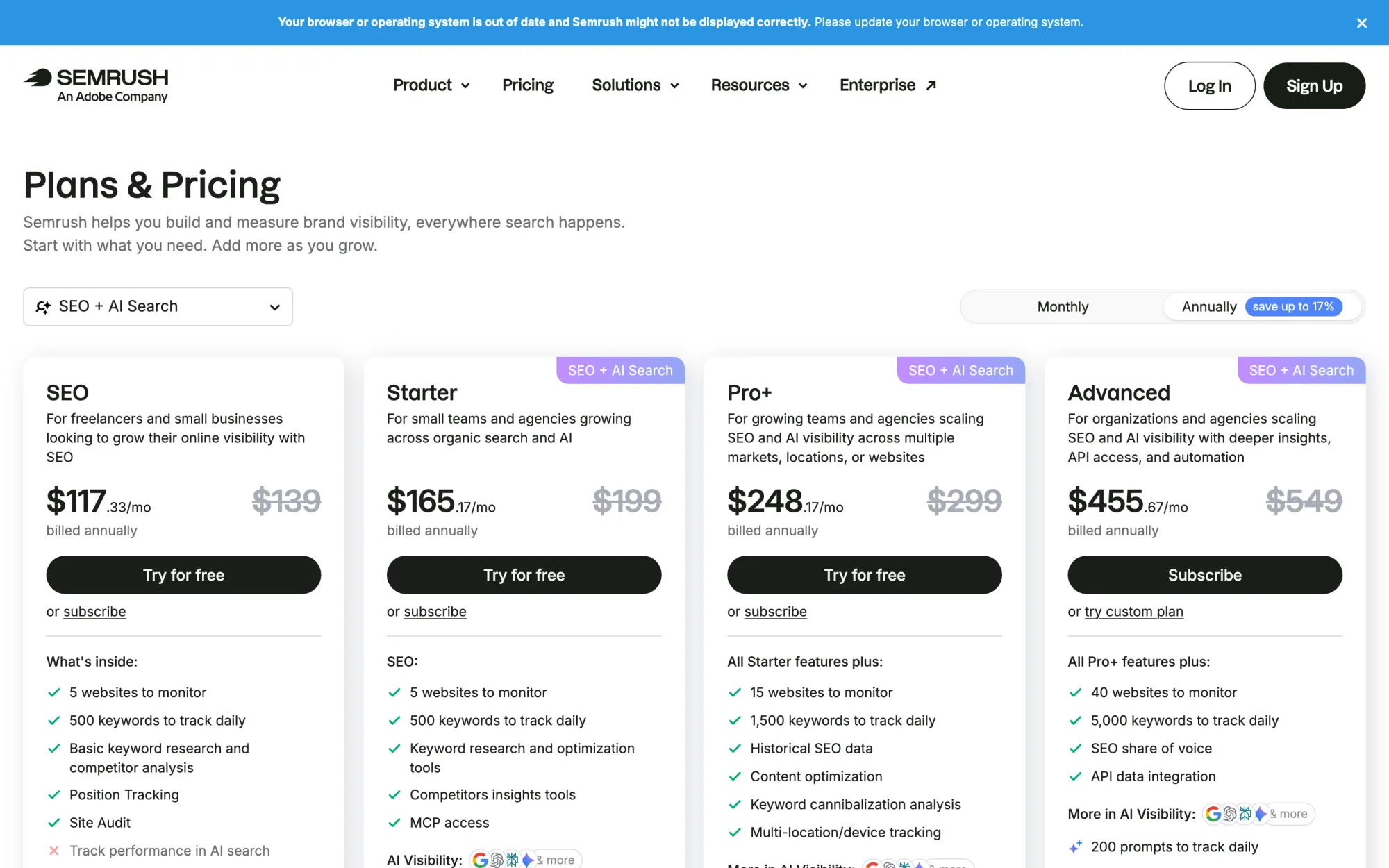
Pricing model. SEO $139, Starter $199, Pro+ $299 and Advanced $549 a month billed monthly, with annual billing saving up to 17% ($117.33 to $455.67); AI prompt tracking is metered at 50, 100 and 200 prompts daily by tier, and a free $0 plan offers one demo project.
| Semrush plan | Price | What the page says |
|---|---|---|
| Free | $0 | 1 demo project, 10 reports/day, no AI visibility features |
| SEO | $139/mo | AI search performance, sentiment, custom prompts |
| Starter | $199/mo | 50 prompts daily; MCP access |
| Pro+ | $299/mo | 100 prompts daily; 15 sites, 1,500 keywords |
| Advanced | $549/mo | 200 prompts daily; API data integration; SEO share of voice |
Tier facts rendered from semrush.com/pricing, August 2026.
03
What Yext is
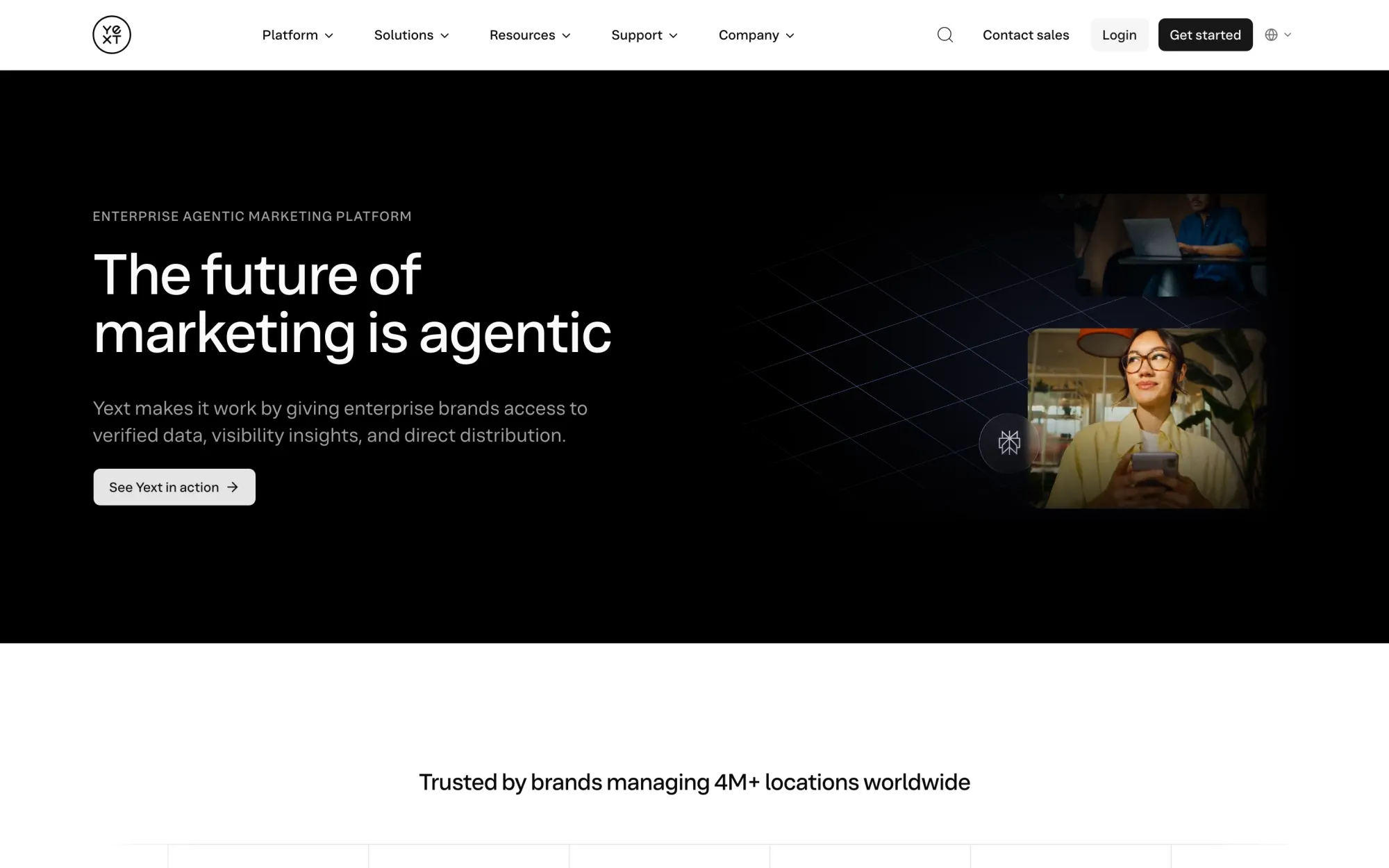
Yext built the category for managed business data at enterprise scale. Its platform navigation lists Scout, Listings, Knowledge Graph, Reviews, Social, Pages, Search, Hearsay Social, Hearsay Relate and Yext AI, with industry solutions for financial services, healthcare, retail, food and hospitality. The model: the Knowledge Graph holds the verified facts about every location, Listings syndicates them everywhere that matters, Pages hosts location landing pages, and Reviews and social tools manage the conversation around them.
Pricing model. Demo-led; yext.com/pricing returned a page-not-found when rendered, so no dollar figure is claimable from their public site.
| Yext plan | Price | What the page says |
|---|---|---|
| Platform | No price published | /pricing 404s; every CTA is Get a Demo |
Tier facts rendered from yext.com, August 2026.
04
AI engine coverage
Semrush. The features page publishes the engine list: ChatGPT, Perplexity, Gemini, Claude and AI Overviews, making Semrush one of the few big suites with Claude included. Grok, DeepSeek and Google AI Mode do not appear in that list.
Yext. Scout appears in the platform navigation as Yext's AI search product; its engine list and tracking depth are not described on the rendered pages, so specifics need verification with their team. No named AI engines appear on the pages we rendered.
Summarized: Semrush reads 5: ChatGPT, Perplexity, Gemini, Claude, AI Overviews; Yext reads scout listed; scope not described publicly. On Claude specifically, Semrush: yes; Yext: not stated.
05
Tracking and measurement mechanics
Semrush. AI prompt tracking meters by tier: 50 prompts daily on Starter, 100 on Pro+, 200 on Advanced, alongside classic position tracking with 500 to 5,000 keywords and 5 to 40 monitored websites. AI brand sentiment and AI visibility reports for any domain ship from the $139 SEO plan.
Yext. The platform's discipline is data consistency across the ecosystem: syndicating verified facts from the Knowledge Graph to directories, search engines and maps. Position measurement in the rank-tracking sense appears nowhere on the rendered public pages.
06
Content production
Semrush. The content toolkit generates full-length, SEO-ready articles from a brief, with AI features woven through Domain Overview and Keyword Suggestions. CMS publishing targets are not enumerated on the pricing or features pages, so where the generated article lands is a question for their sales team.
Yext. Pages is the content surface: location landing pages generated and hosted from Knowledge Graph data at scale, common in multi-hundred-location deployments. There is no long-form article product on the rendered pages.
07
SEO and local coverage
Semrush. Classic SEO is the suite's backbone: position tracking, a technical site audit crawler, the 28B-keyword research database and the 43T-link backlink index. A local toolkit with listing management and map rank tracking exists; whether it draws a geo-grid or covers Apple Maps is not stated on the rendered pages.
Yext. Listings syndication for large location counts is the core: one source of truth pushed everywhere, with Reviews for monitoring and response and industry-specific solutions layered on. This is distribution infrastructure more than measurement tooling.
08
Data access, APIs and integrations
Semrush. MCP access lists from the $199 Starter tier and API data integration only on the $549 Advanced tier. White-labeling arrives through the Pro Report add-on at $20 a month, and the suite's own research database is the underlying asset most buyers pay for.
Yext. Platform APIs are documented (Point and Click, SDK, APIs per their documentation section) and the Knowledge Graph is the structured-data asset underlying everything. Evaluation runs through enterprise demos.
09
The full ledger
Every cell below was read from the vendors’ own rendered pages as of August 2026. Where a vendor’s public pages neither confirm nor deny a capability, the cell says so.
| Dimension | Semrush | Yext |
|---|---|---|
| AI engines | 5: ChatGPT, Perplexity, Gemini, Claude, AI Overviews | Scout listed; scope not described publicly |
| Claude coverage | Yes | Not stated |
| Tracking cadence | Daily prompt allowances by tier (50 to 200) | Data sync, not position measurement |
| Google rank tracking | Yes (position tracking) | Not listed |
| Local / map tracking | Local toolkit; geo-grid not stated publicly | Listings distribution at enterprise scale |
| Content output | SEO-ready article generation from a brief | Pages product (location landing pages) |
| CMS publishing | Not enumerated publicly | Own Pages platform |
| API / MCP | MCP from $199; API on the $549 tier | APIs documented for the platform |
| Entry price | $0 demo project; paid from $139/mo | Demo call; /pricing 404s |
Sources: semrush.com/pricing and /features; yext.com (pricing URL 404s). Rendered in a browser, August 2026.
10