Compared
Rank.ai vs Semrush AI Visibility
Semrush is a nine-toolkit suite where AI visibility is one metered module. Rank.ai tracks seven AI engines daily, records every answer with its sources, then writes and publishes the pages those answers are missing. This guide walks both screen by screen, with prices from their live pricing page and ours.
01
The short answer
Semrush, now an Adobe company, is the biggest suite in search marketing: 28B keywords, 43T backlinks, nine toolkits, and an AI visibility module that meters tracked prompts by tier. That scale is real and we do not pretend to match it on backlink data or site auditing. The comparison that matters is the AI visibility job itself. Semrush’s published engine list is five; ours is seven, adding Grok and DeepSeek. Semrush reports scores inside the app; we record the answers themselves, with every cited source, and publish daily boards anyone can open without an account. When an AI answer stops naming you, one platform shows you the graph. This one shows you the answer, the page it cites, and then ships the page that wins it back.
Choose Rank.ai when
- AI visibility and content are the job, and you want it run end to end
- You want the recorded answers behind every number, in public
- Grok and DeepSeek belong on the record next to the big five
- The missing pages should ship into your CMS, 10 a month at $0
Choose Semrush when
- You will use the whole suite: backlink index, site audit, research database
- One vendor across SEO, ads, social and PR beats a focused tool
- You need their 28B-keyword research corpus daily
- An Adobe-scale vendor relationship matters to procurement
02
A suite next to a pipeline
Semrush sells breadth. Nine toolkits share one login, and AI visibility is one of them: prompt tracking metered by tier, sentiment, share of voice, and reports inside the app. Rank.ai is shaped around one loop: put the market’s buying questions to seven engines daily, record every answer with the brands named and the sources cited, rank the pages the answers are built from, then write and publish the missing pages into WordPress, Webflow, Shopify or WordPress.com with your approval.
The natural instinct with a suite on the bill is to let one of its modules cover each new surface, and that works when the new surface behaves like the old ones. This one does not. Google rank is one observable number per keyword per day. An AI answer is a paragraph that changes run to run, names several brands at once, carries sentiment, and rests on citations that shift underneath it. Measuring that surface takes repeated daily sampling, transcript storage, mention extraction and citation attribution down to the sentence. A metered module inside a nine-toolkit suite reports on this surface. A system of record runs it.
03
Every answer recorded, mention by mention
Rank.ai runs each question as multiple samples per engine, because the same prompt answers differently run to run and one sample is noise. Every run stores the full answer text. Every brand mention is extracted with its exact character position, the sentence around it, a sentiment call on that specific mention, and the brand’s domain, so competitors you never listed still get identified when an engine starts recommending them. Every citation is stored with its URL, title, position in the answer and an attribution flag: yours, a tracked competitor’s, or neutral. For engines that search before answering, the record includes the Google queries the model actually issued, the closest thing that exists to a keyword list for AI answers.
A share-of-voice percentage tells you that something changed. This record tells you what changed: which competitor got named, in which sentence, on the strength of which cited page.
04
The missing pages, written and published to your site
Because every answer is stored with its citations, the platform can rank the pages AI engines actually lean on in your market and flag the questions where you have no cited page at all. That queue feeds the article pipeline: research against live search results, an outline, a full draft, an editorial review loop that revises each section against the research, generated images, then publication into WordPress, Webflow, Shopify or WordPress.com once you approve it. The pipeline runs on rules you set once: a weekly cadence, a theme list, title and style direction, pasted examples of your own writing so drafts come out in your voice, and a competitor-domain blacklist the writer is hard-blocked from linking to, subdomains included.
Semrush’s content tool generates articles from a brief too; on their published pages the workflow ends with the article in hand. Ours ends with the article live on your site and the tracker watching whether the answers start citing it. The free plan publishes 10 articles a month, so the loop from detected gap to published page costs $0 to try.
05
A public record you can audit before you pay
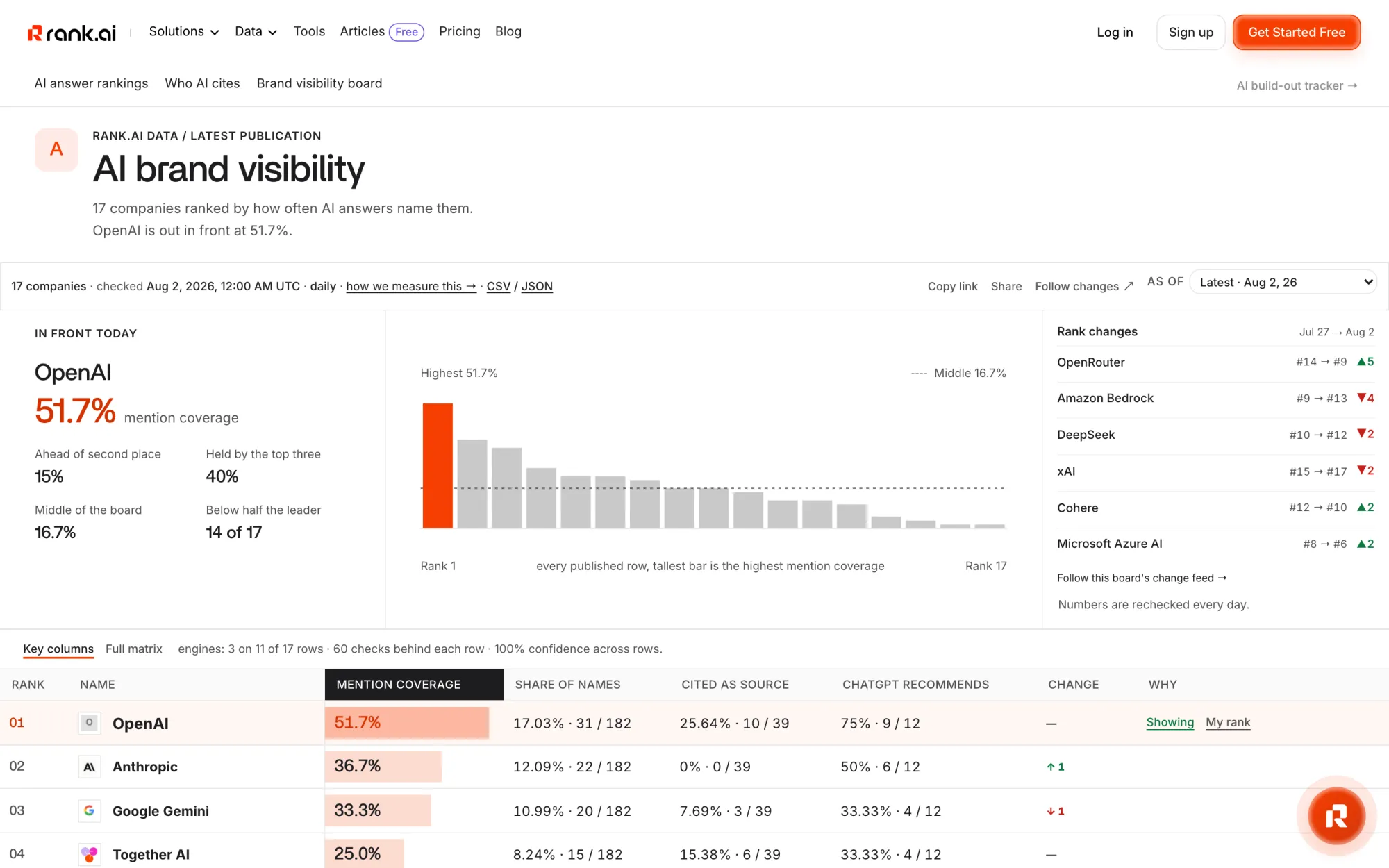
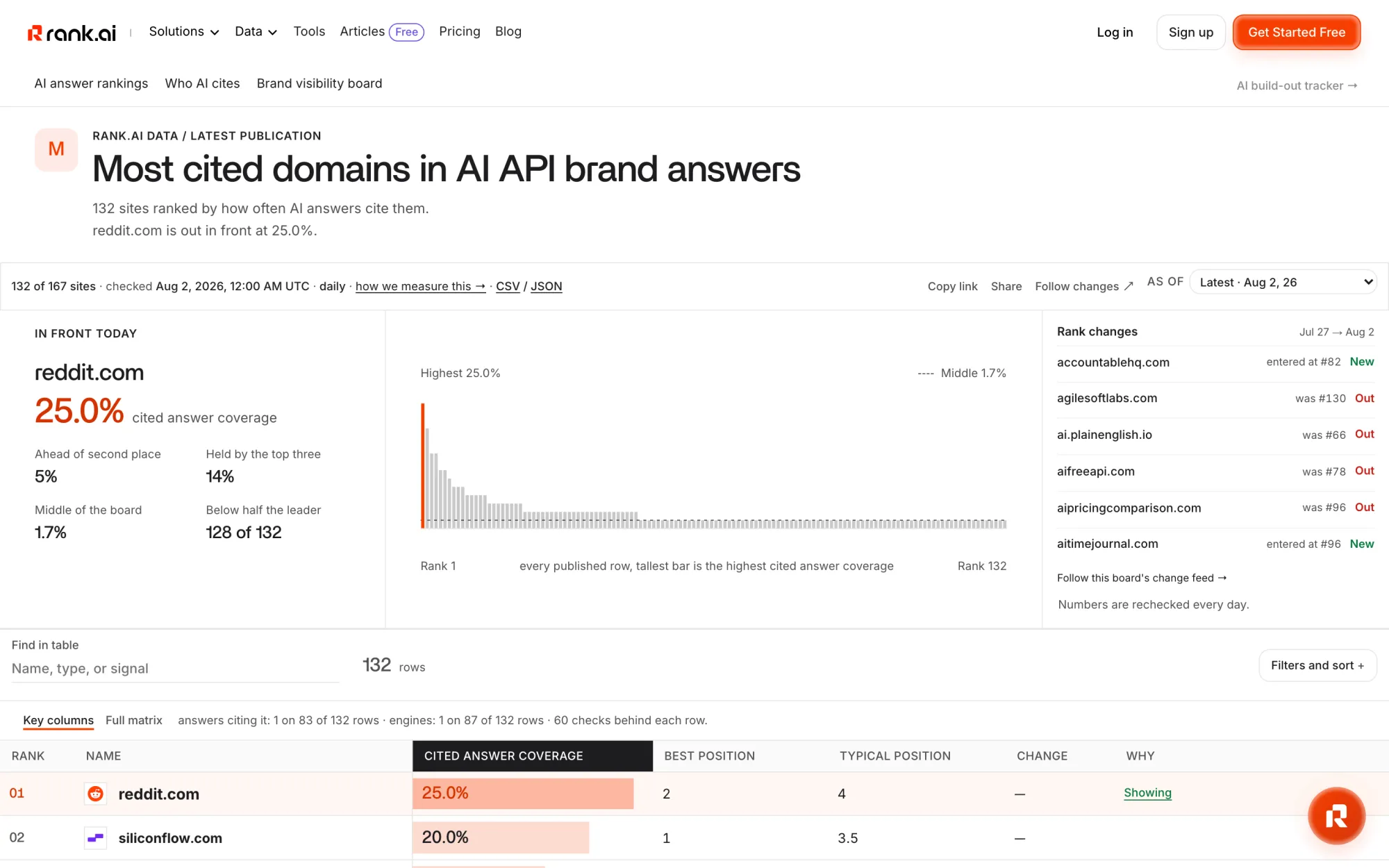
Rank.ai publishes daily boards of recorded AI answers, open to anyone without an account: the question asked, the answer each engine gave that day, the brands named and the sources cited. Semrush’s public AI Visibility Index shows aggregate mention leaderboards; the answer-level data sits inside the app. Being able to read the raw answers matters twice: before you buy, it lets you check that the measurement is real, and after you buy, it means every number in a client report can be traced to an answer a human can read. Any dashboard can be shared as a read-only link, the free tools run one-off checks with no signup, and the embeddable widget puts a live visibility check on your own site, a surface Semrush does not offer.
06
Local map rankings on the same login
The local rank tracker places a grid of probe points across your service area and checks your map-pack rank from each one, because rank on Google Maps changes block by block and a single citywide number hides exactly the blocks you are losing. The result is a daily heatmap of where you win and where you vanish, and the same grid records each tracked competitor’s rank at every point, so a falling block comes with a name attached. Pricing is legible: one credit per grid point, a 3x3 scan costs 9 credits, a 10x10 costs 100. It covers Google Maps and Apple Maps, grades your Google Business Profile and monitors directory citations. Semrush ships a local toolkit with listing management and map rank tracking; whether it draws a geo-grid or covers Apple Maps is not stated on the pages we rendered, so the ledger marks those cells verify with vendor.
07
Pricing in practice
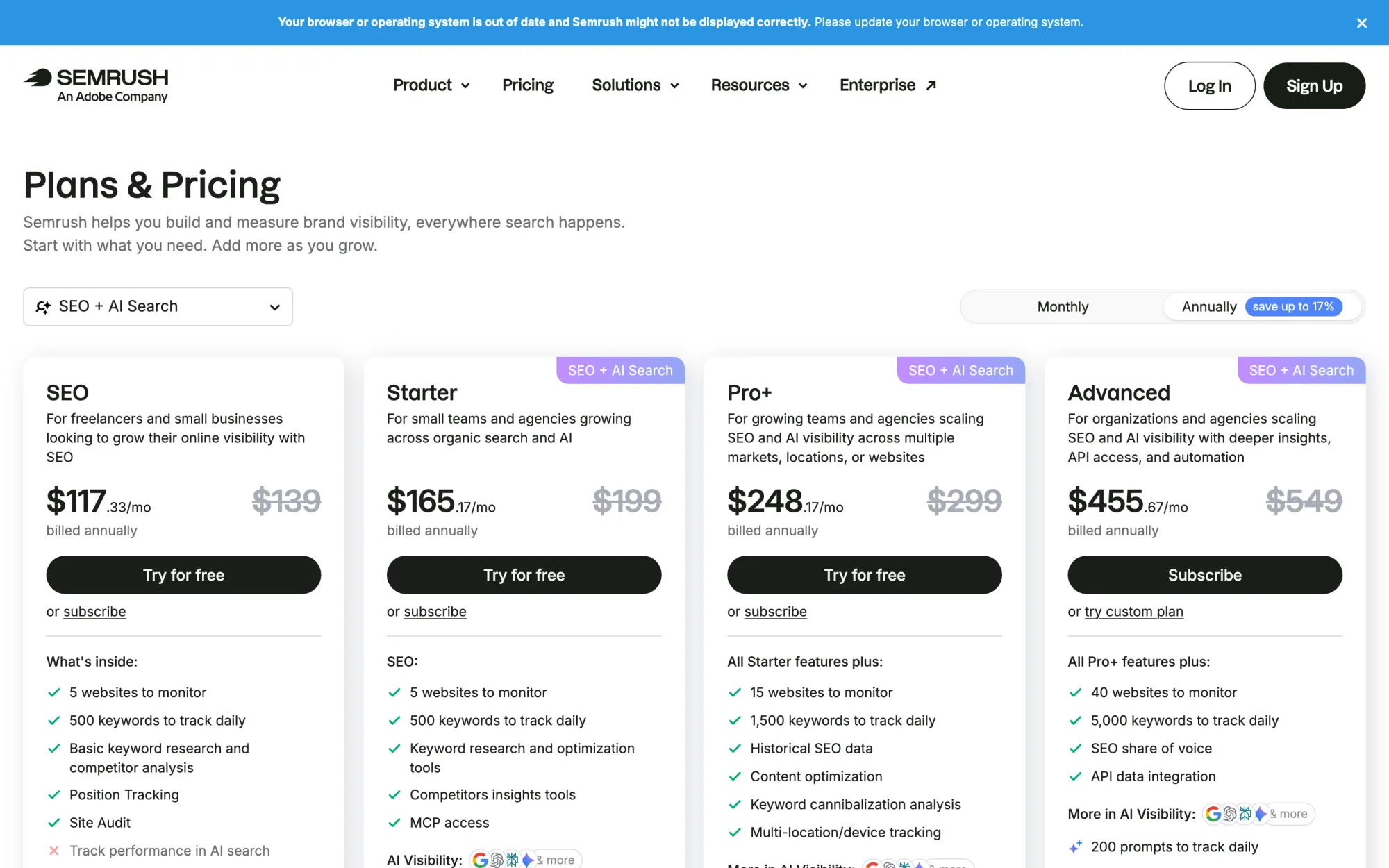
Both publish prices and both start at $0. Semrush’s paid tiers billed monthly are SEO $139, Starter $199, Pro+ $299 and Advanced $549, with annual billing saving up to 17%. AI prompt tracking is metered by tier: 50 prompts daily on Starter, 100 on Pro+, 200 on Advanced. MCP access lists from Starter, API data integration only on Advanced, and white-labeling arrives through the Pro Report add-on at $20 a month.
Rank.ai’s free plan publishes 10 finished articles a month to your connected site and tracks 3 Google keywords daily, with no card. AI answer tracking starts on Starter at $50 a month, and Pro at $250 raises the limits, adds every engine and the MCP server. If you will use the whole Semrush suite, the suite price buys a lot. If AI visibility and content are the job, you get further here for less.
08
The full ledger
Every Semrush cell was verified by loading semrush.com/pricing and semrush.com/features in a browser. Where their public pages neither confirm nor deny a feature, the cell says verify with vendor. Where we are behind, the ledger says so.
| Capability | Rank.ai | Semrush |
|---|---|---|
| AI engines | ||
| ChatGPT, Claude, Gemini + Perplexity tracking | Yes | Yes |
| Google AI Overviews tracking | Yes | Yes |
| Grok rank tracking | Yes | Not listed |
| DeepSeek mention tracking | Yes | Not listed |
| Brand sentiment in AI answers | Yes | Yes |
| Cited-source tracking per answer | Yes | Yes |
| Public daily boards with recorded answers | Yes | No |
| Content + links | ||
| AI article writing | Yes | Yes |
| CMS publishing | WordPress, Webflow, Shopify, WordPress.com | Verify with vendor |
| Peer-to-peer backlink exchange | Yes | No |
| Backlink index | No | Yes |
| Technical site audit crawler | No | Yes |
| Local | ||
| Geo-grid heatmap for local pack | Yes | Verify with vendor |
| Apple Maps rank tracking | Yes | Verify with vendor |
| Platform | ||
| Embeddable AI visibility widget | Yes | No |
| MCP server for AI assistants | Pro plan | Starter plan |
| Public API | In roadmap | $549 tier |
| Published pricing with a $0 plan | Yes | Yes |
Sources: semrush.com/pricing/, semrush.com/features/, semrush.com homepage, rendered in a browser August 2026. Rank.ai cells sourced from backend code and rank.ai/pricing.
09
Frequently asked
What is the core difference between Rank.ai and Semrush?
I need a backlink index and site audit. Do you ship those?
Which AI engines does each platform track?
Do you have an API?
Do you do white-label reporting?
How does pricing compare?
Does Semrush record the actual AI answers?
What do I lose and gain if I switch from Semrush to Rank.ai?
See your AI rankings today
The free plan records what the AI engines answer about your market, publishes 10 articles a month to your site and costs $0 with no card. Compare the answer data yourself.