Compared
LocalFalcon vs Moz
LocalFalcon is a geo-grid rank tracker; Moz is a SEO suite. This guide compares the two in depth, engine coverage, tracking mechanics, content production, SEO and local surfaces, data access and full pricing tiers, using only facts read from their live pages.
01
The short answer
LocalFalcon is the geo-grid incumbent: map-pack scans across real grid points on Google and Apple Maps, an eight-platform AI visibility lineup, and Falcon Agent for GBP automation. Moz, a Ziff Davis company, is the veteran SEO suite: Domain Authority, a 40-trillion-link index, keyword research, site crawls, and an AI module tracking two to three models weekly. They compete only where the categories overlap, and the chapters below walk every dimension a buyer would price: which AI engines each can see, how the tracking actually meters, what each produces on the content side, what surrounds the core product, and the full published tier lists.
Choose LocalFalcon when
- Apple Maps geo-grids next to Google
- Lead capture on the embeddable scan widget
- Looker Studio and Zapier integrations
- White label reports on the Premium tier
Choose Moz when
- Domain Authority and Brand Authority metrics
- A 40T-link index and 1.25B-keyword research base
- Moz Local handles listings distribution
- Moz Academy and a deep learning ecosystem
02
What LocalFalcon is
LocalFalcon popularized the geo-grid scan and remains the reference tool for it: pick a business, lay a grid of points across its service area, and record the map-pack rank at every point. The platform has since widened into AI search visibility across an eight-platform lineup, Falcon Guard monitoring of Google Business Profiles, and Falcon Agent, which replies to reviews and schedules GBP posts. Everything meters through credits, where one credit is one map pin on a scan.
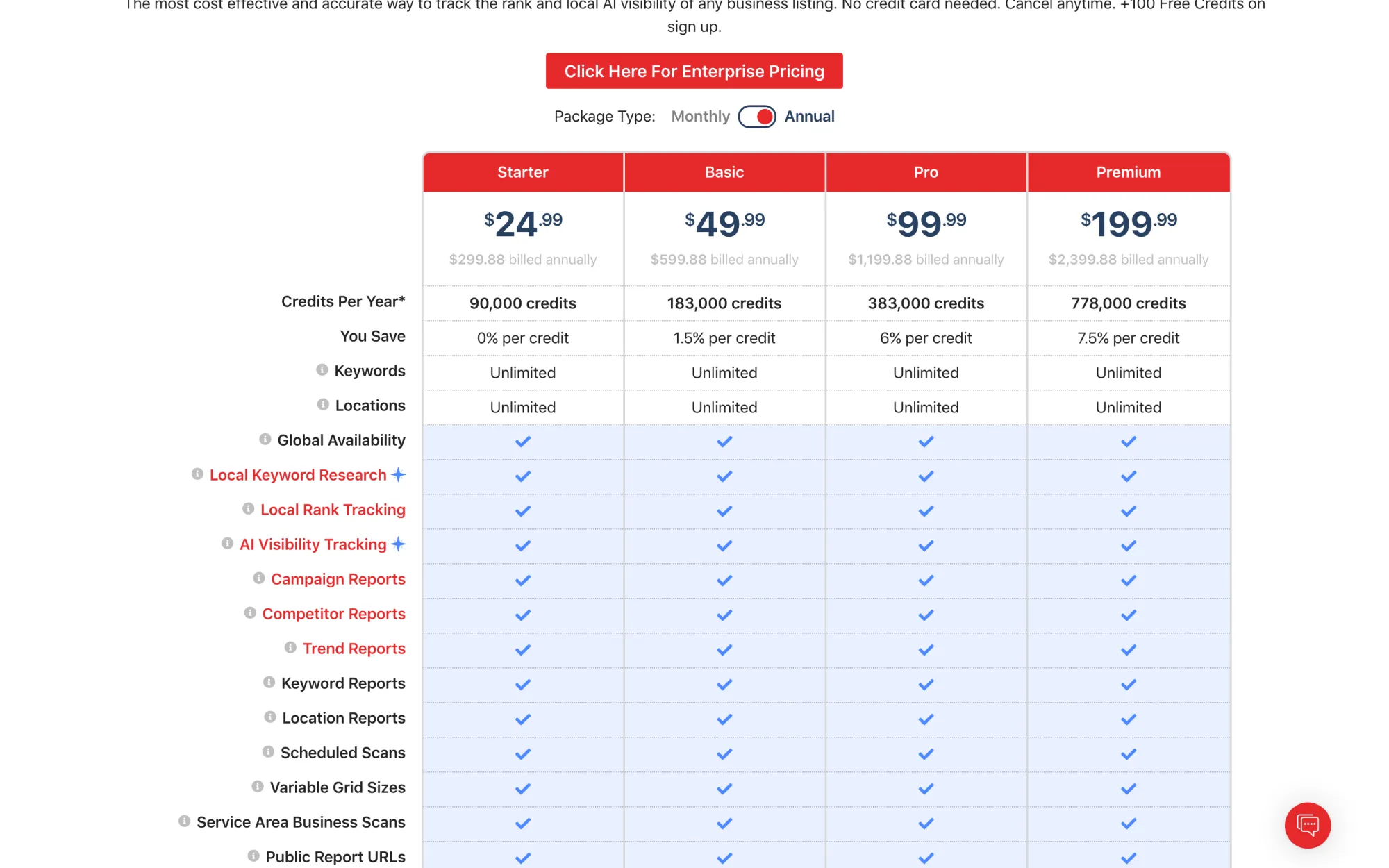
Pricing model. Starter $24.99, Basic $49.99, Pro $99.99 and Premium $199.99 a month billed annually ($299.88 to $2,399.88 a year), with credit allotments from 90,000 to 778,000 a year; unused plan credits expire each billing cycle and pay-as-you-go credits are available in the portal.
| LocalFalcon plan | Price | What the page says |
|---|---|---|
| Starter | $24.99/mo | annual; 90,000 credits/yr, unlimited keywords and locations |
| Basic | $49.99/mo | 183,000 credits/yr, 1.5% cheaper per credit |
| Pro | $99.99/mo | 383,000 credits/yr |
| Premium | $199.99/mo | 778,000 credits/yr; the only tier with white label reports |
Tier facts rendered from localfalcon.com/pricing, August 2026.
03
What Moz is
Moz was the first name in SEO software and remains one of the most trusted, now a Ziff Davis company, with Domain Authority and Brand Authority as industry-standard metrics, a link index past 40 trillion links, a 1.25B-keyword research base, and Moz Academy behind it. Moz Pro carries the suite: keyword research, competitive research, site crawls up to 1.25M pages a week, weekly rank tracking, and a new AI and GEO feature set with visibility dashboards, prompt tracking, citations data and content briefs. Moz Local and STAT sell separately for listings management and enterprise SERP tracking.
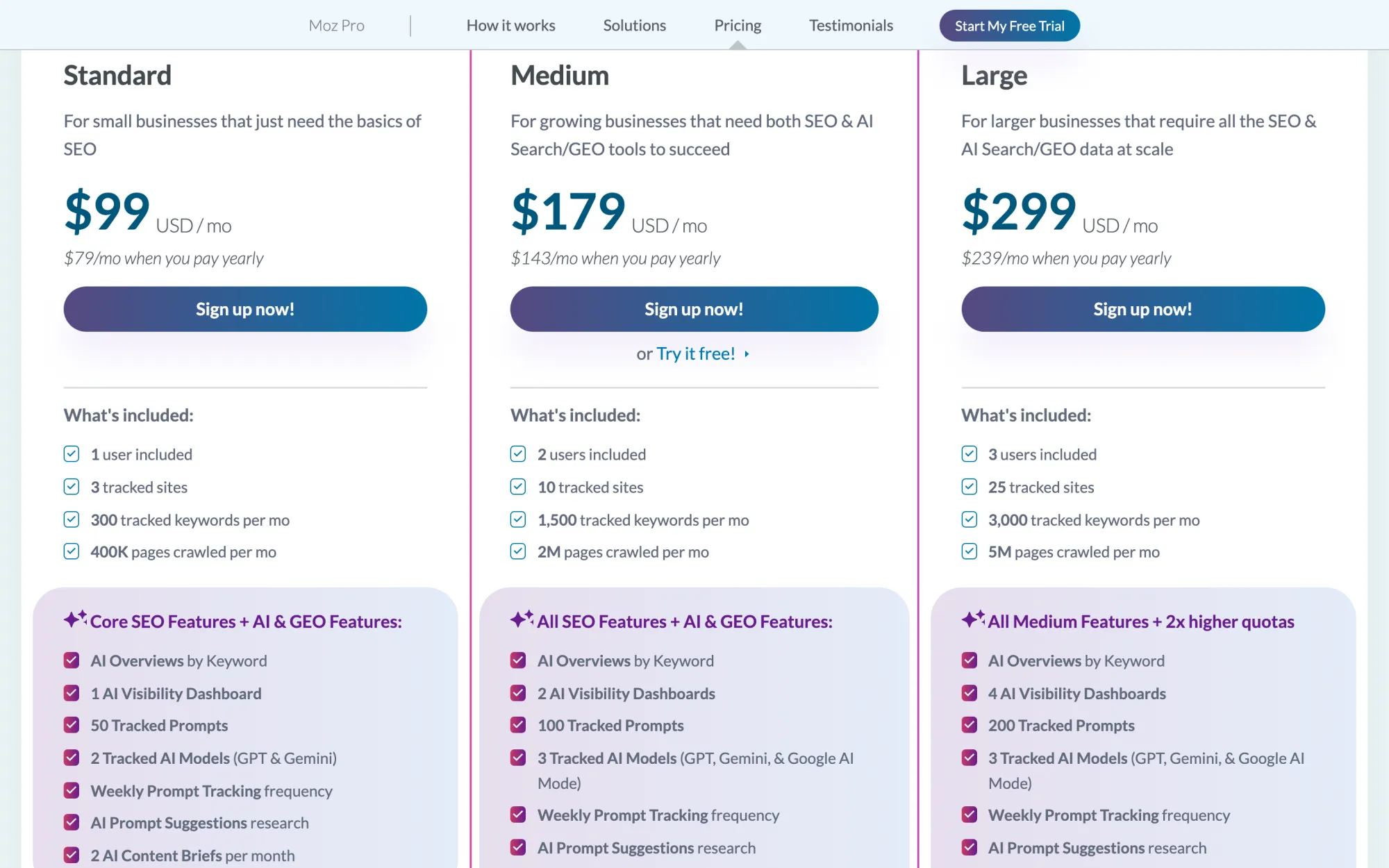
Pricing model. Standard $99, Medium $179 and Large $299 a month (20% off yearly: $79, $143, $239), with a $49 single-site starter plan; extra AI prompts cost $50 per 100, extra dashboards $20 each, and add-on seats $49 per user.
| Moz plan | Price | What the page says |
|---|---|---|
| Starter | $49/mo | single website |
| Standard | $99/mo | 50 prompts, 2 models (GPT, Gemini), weekly; 2 briefs/mo |
| Medium | $179/mo | 100 prompts, 3 models (+ AI Mode); 10 briefs; free trial |
| Large | $299/mo | 200 prompts, 3 models; 50 briefs; branded reports |
Tier facts rendered from moz.com/products/pro/pricing, August 2026.
04
AI engine coverage
LocalFalcon. The features page lists eight tracked AI platforms: ChatGPT, Gemini, Perplexity, Grok, AI Mode, Apple Intelligence, Copilot and Google AI Overviews. Claude is absent from that lineup; the Claude Connector in their integrations section pipes LocalFalcon data into Claude for querying, which is an integration, and answer tracking of Claude is not offered.
Moz. The tracked AI models are GPT and Gemini on the $99 Standard plan, with Google AI Mode joining from the $179 Medium plan, three models at most. Claude, Perplexity, Grok and DeepSeek appear nowhere in the tracked-model lists on the Moz Pro pricing page.
Summarized: LocalFalcon reads 8 tracked: ChatGPT, Gemini, Perplexity, Grok, AI Mode, Apple Intelligence, Copilot, AI Overviews; Moz reads 2 (GPT, Gemini) on $99; 3 (+ AI Mode) from $179. On Claude specifically, LocalFalcon: no (their Claude Connector is an integration, not tracking); Moz: not listed.
05
Tracking and measurement mechanics
LocalFalcon. Scans run on demand or on schedules, metered in credits with one credit per grid point, across variable grid sizes and service-area business modes. Coverage spans Google Maps and Apple Maps side by side, with campaign, competitor, trend, keyword and location reports layered on top. The pricing footnote states that unused plan credit allotments expire at the end of each billing cycle.
Moz. Both halves of tracking run weekly: AI prompt tracking frequency reads weekly on every tier, and the rank tracker checks each keyword weekly across Google US and international, Google Mobile, Yahoo and Bing, with 300 to 3,000 keywords by tier. AI citations data and prompt suggestions ship on every tier, and extra prompts are $50 per 100.
06
Content production
LocalFalcon. Falcon Agent replies to new four and five star reviews and schedules Google Business Profile posts, and the platform runs content audits. Nothing on the features page writes long-form articles or publishes to a CMS.
Moz. Content output is AI Content Briefs: 2 a month on Standard, 10 on Medium, 50 on Large. There is no article writer and no CMS publishing; briefs hand off to your writers.
07
SEO and local coverage
LocalFalcon. Local is the core: geo-grids on Google and Apple Maps, Falcon Guard monitoring GBP for unauthorized edits and performance shifts, and an embeddable scan widget that can capture lead contact info on your own site. White label reports are ticked only on the Premium tier at $199.99 a month.
Moz. Moz Pro carries the classic research stack with Domain Authority at its center, plus site crawls to 1.25M pages a week and an On-Page Grader. Local is a separate product, Moz Local, which syncs listings to directories; its pricing did not render dollar figures when checked, and no geo-grid appears on the Moz Pro page.
08
Data access, APIs and integrations
LocalFalcon. Integrations include Looker Studio, Zapier, n8n, an MCP server and an API, plus public shareable report URLs for scans. The credit model prices everything in map pins, with per-credit discounts rising by tier.
Moz. The Moz API sells separately with its own flexible pricing, and no MCP server is listed. Branded reports and report templates arrive on the Large tier, and MozBar Premium ships with every plan.
09
The full ledger
Every cell below was read from the vendors’ own rendered pages as of August 2026. Where a vendor’s public pages neither confirm nor deny a capability, the cell says so.
| Dimension | LocalFalcon | Moz |
|---|---|---|
| AI engines | 8 tracked: ChatGPT, Gemini, Perplexity, Grok, AI Mode, Apple Intelligence, Copilot, AI Overviews | 2 (GPT, Gemini) on $99; 3 (+ AI Mode) from $179 |
| Claude coverage | No (their Claude Connector is an integration, not tracking) | Not listed |
| Tracking cadence | Scheduled geo-grid scans, credits per pin | Weekly for both AI prompts and rankings |
| Google rank tracking | Maps-centric; geo-grid on Google and Apple Maps | Yes, weekly, across Google, Mobile, Yahoo, Bing |
| Local / map tracking | Core product, including Apple Maps | Moz Local (separate listings product) |
| Content output | Falcon Agent: review replies and GBP posts | AI Content Briefs, 2 to 50/mo |
| CMS publishing | No | No |
| API / MCP | Looker, Zapier, n8n, MCP, API | Moz API (separate product); no MCP listed |
| Entry price | $24.99/mo (annual) | $49/mo single-site plan |
Sources: localfalcon.com/features and /pricing; moz.com/products/pro/pricing and /products/local. Rendered in a browser, August 2026.
10
Frequently asked
What is the core difference between LocalFalcon and Moz?
How does LocalFalcon's pricing compare to Moz's?
Which AI engines does each cover?
Who should pick LocalFalcon?
Who should pick Moz?
How does Rank.ai compare to LocalFalcon and Moz?
How each compares to Rank.ai
We keep our own product out of this comparison. If you want the same verified treatment with Rank.ai in the frame, the one-on-one guides for LocalFalcon and Moz carry it.