Compared
Rank.ai vs Moz
Moz is the veteran SEO suite: Domain Authority, a 40-trillion-link index, and an AI module that tracks two to three models weekly and hands you briefs. Rank.ai records seven engines daily including Claude and Perplexity, checks Google daily, and publishes the finished articles into your CMS. This guide walks both, with prices from their live pricing page and ours.
01
The short answer
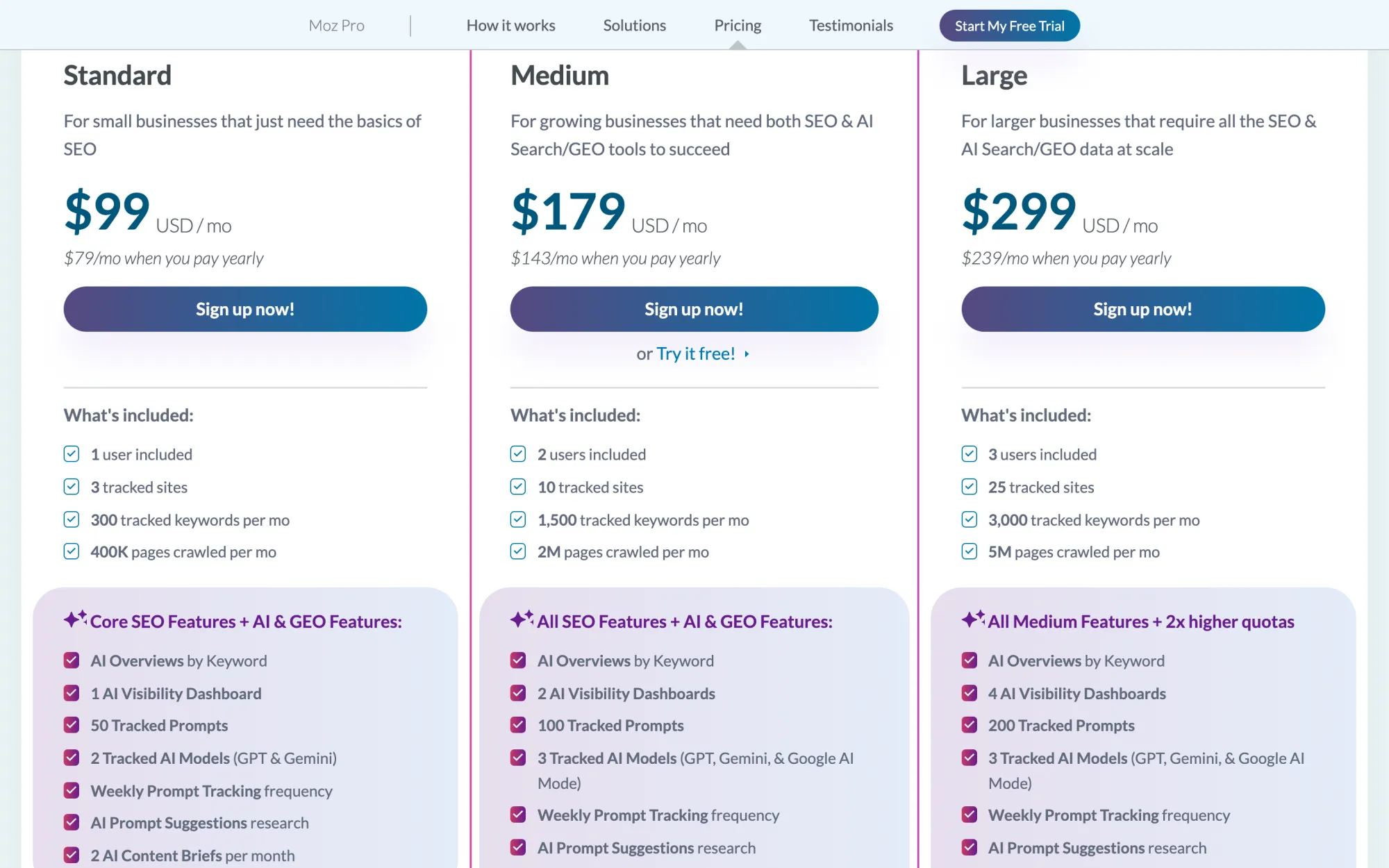
Moz, now a Ziff Davis company, remains one of the most trusted names in SEO: Domain Authority, a link index past 40 trillion links, and twenty years of teaching the industry. Its new AI and GEO features bolt onto that suite: 2 tracked models on the $99 plan, 3 from $179, prompts checked weekly, rankings checked weekly, and content delivered as briefs. Rank.ai starts where that cadence ends: seven engines recorded daily including Claude and Perplexity, Google checked daily on every plan, geo-grid map tracking, and articles researched, written and published into your CMS, 10 a month at $0.
Choose Rank.ai when
- Claude and Perplexity answers belong on the record
- Daily beats weekly for both AI answers and Google ranks
- Briefs should become published pages without a handoff
- You want map-pack tracking street by street
Choose Moz when
- Domain Authority and link research drive your reporting
- You want Moz Local pushing listings to directories
- Google AI Mode coverage matters more than Claude
- The team learns from Moz Academy and its ecosystem
02
What each platform does
Moz Pro is a research and monitoring suite: keyword research on a 1.25B-keyword index, link analysis, site crawls, weekly rank tracking across Google, Google Mobile, Yahoo and Bing, and an AI visibility dashboard with citations data and prompt suggestions. Its output is insight and briefs.
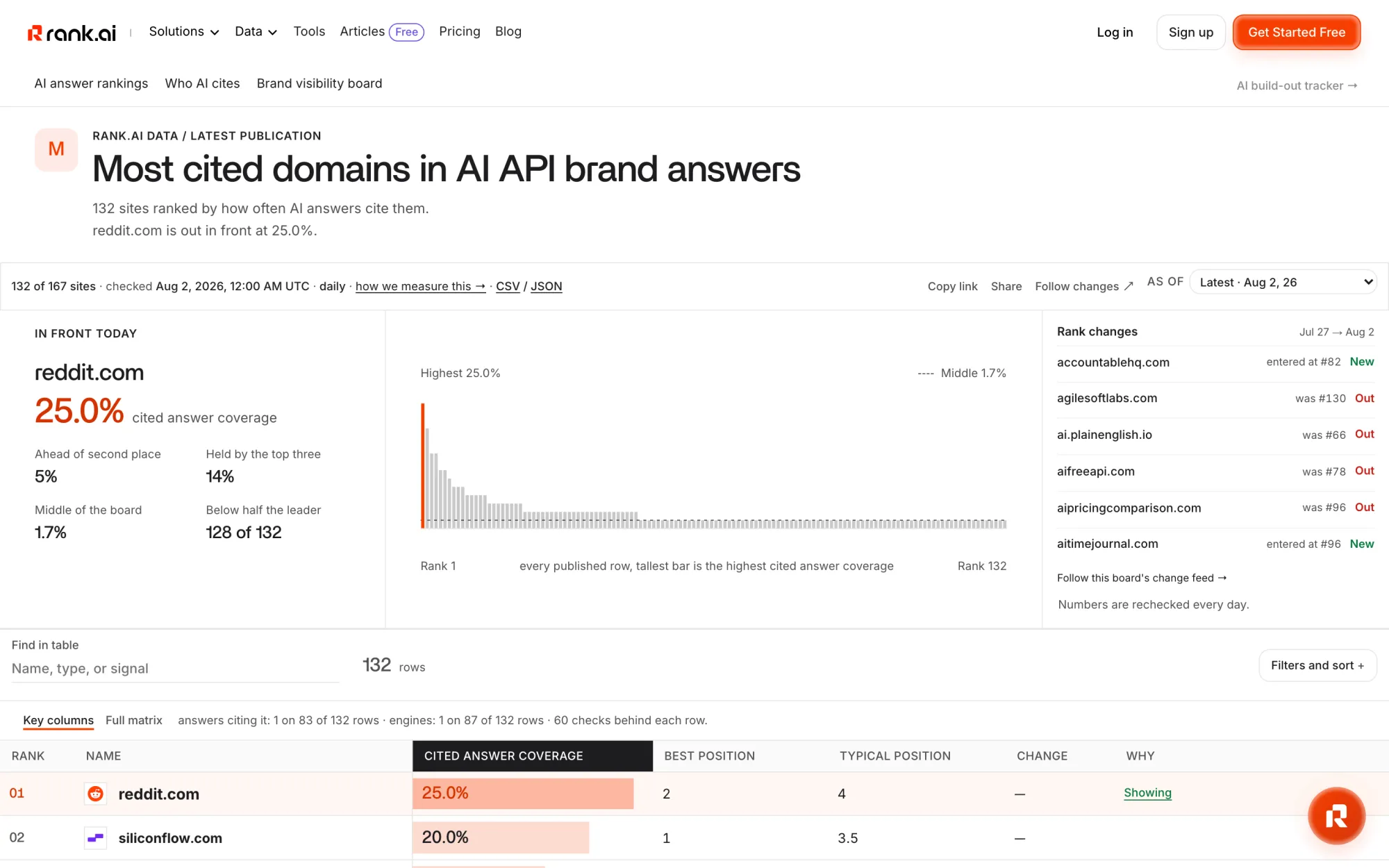
Rank.ai runs the loop on your own brand: seven engines asked your buying questions daily, every answer stored with brands, sentiment and cited sources, Google and geo-grid map ranks checked daily, and the article pipeline publishing the fixes into WordPress, Webflow, Shopify or WordPress.com with your approval. The measurement runs in public on the daily boards, no account needed.
03
Daily records next to weekly checks
Moz’s prompt tracking frequency reads Weekly on every tier, and its rank tracking is weekly across four search engines. Rank.ai samples every tracked question daily, three runs per engine to smooth model randomness, and checks Google daily on every plan including the free one. AI answers flip faster than rankings; a weekly sample can miss the whole week that mattered. When something changes, you open that day’s recorded answer, read the sentence that replaced you, and see the page it cited.
04
Engine coverage
Moz’s tracked models are GPT and Gemini at $99, plus Google AI Mode from $179. Claude, Perplexity, Grok and DeepSeek appear nowhere on the pricing page, and extra prompts cost $50 per 100. Rank.ai runs every question on ChatGPT, Claude, Gemini, Perplexity, Grok, Google AI Overviews and DeepSeek, on every paid plan, with no per-model fees and no prompt packs. We do not track AI Mode or Copilot today, and the ledger says so.
05
Briefs next to published pages
Moz’s content output is AI Content Briefs: 2 a month on Standard, 10 on Medium, 50 on Large. A brief is the middle of the job; the writing, formatting, images and publishing still land on your team. Rank.ai’s pipeline finishes the distance: research against live search results and the sources AI answers cite, a full draft in your voice, generated images, your approval gate, and publication into WordPress, Webflow, Shopify or WordPress.com. Ten published articles a month are included at $0, and the tracker reports whether the answers start citing them. The backlink exchange rides on the same publishing, with your competitor blacklist enforced on every match.
06
The full ledger
Every Moz cell below is grounded in the rendered text of moz.com/products/pro/pricing. Where Rank.ai is behind, the cell says so.
| Capability | Rank.ai | Moz |
|---|---|---|
| AI answer tracking | ||
| Tracked AI models | 7, every paid plan | 2 on $99, 3 on $179+ |
| Claude tracking | Yes | Not listed |
| Perplexity tracking | Yes | Not listed |
| Grok + DeepSeek tracking | Yes | Not listed |
| Google AI Mode tracking | No | $179 plan and up |
| Prompt tracking frequency | Daily | Weekly, every tier |
| Extra prompts | Credit pool, half a cent each | $50 per 100 prompts |
| AI citations data | Yes | Yes |
| Public daily boards with recorded answers | Yes | No |
| Google + local | ||
| Google rank tracking frequency | Daily, every plan | Weekly |
| Geo-grid map-pack tracking | Yes | No |
| Listings management | No | Moz Local (separate product) |
| Backlink index | No | 40T+ links |
| Domain Authority metric | No | Yes |
| Site crawl / audit | No | Yes |
| Content + platform | ||
| Content output | Published articles, 10 to 100/mo | AI Content Briefs, 2 to 50/mo |
| CMS publishing | WordPress, Webflow, Shopify, WordPress.com | No |
| Peer-to-peer backlink exchange | Yes | No |
| MCP server | Pro plan | Not listed |
| Free tools without signup | Yes | Yes |
| Entry price | $0, no card | $49/mo single-site plan |
Sources: moz.com/products/pro/pricing and moz.com/products/local, rendered in a browser August 2026. Rank.ai cells sourced from backend code and rank.ai/pricing.
07
Frequently asked
What is the core difference between Rank.ai and Moz?
Which AI models does Moz track?
Why does daily vs weekly matter for AI answers?
Does Moz write content?
What about Moz Local and listings?
What do I lose by not having Moz?
How does pricing compare?
See your AI rankings today
The free plan records what the AI engines answer about your market, publishes 10 articles a month to your site and costs $0 with no card. Run it beside Moz and compare the output.