Compared
Whitespark vs Yext
Whitespark is a local SEO tools (unbundled); Yext is a digital presence platform. This guide compares the two in depth, engine coverage, tracking mechanics, content production, SEO and local surfaces, data access and full pricing tiers, using only facts read from their live pages.
01
The short answer
Whitespark sells local SEO as separate tools: a Google and Bing rank tracker, ranking grids, the Citation Finder, Reputation Builder and a managed Listings Service, each with its own price. Yext is the enterprise platform for managing business data: a Knowledge Graph as source of truth, Listings syndication, Reviews, Pages, and Scout as its listed AI search product. They compete only where the categories overlap, and the chapters below walk every dimension a buyer would price: which AI engines each can see, how the tracking actually meters, what each produces on the content side, what surrounds the core product, and the full published tier lists.
Choose Whitespark when
- The deepest citation research tools in the industry
- One-time managed listings cleanup you own once done
- Review requests over email, SMS and kiosk across 100+ sites
- White-label share reports on a custom domain
Choose Yext when
- Listings syndication for hundreds of locations
- Knowledge Graph as a single source of truth
- Industry solutions for finance, healthcare, retail
- Reviews and social tooling in one platform
02
What Whitespark is
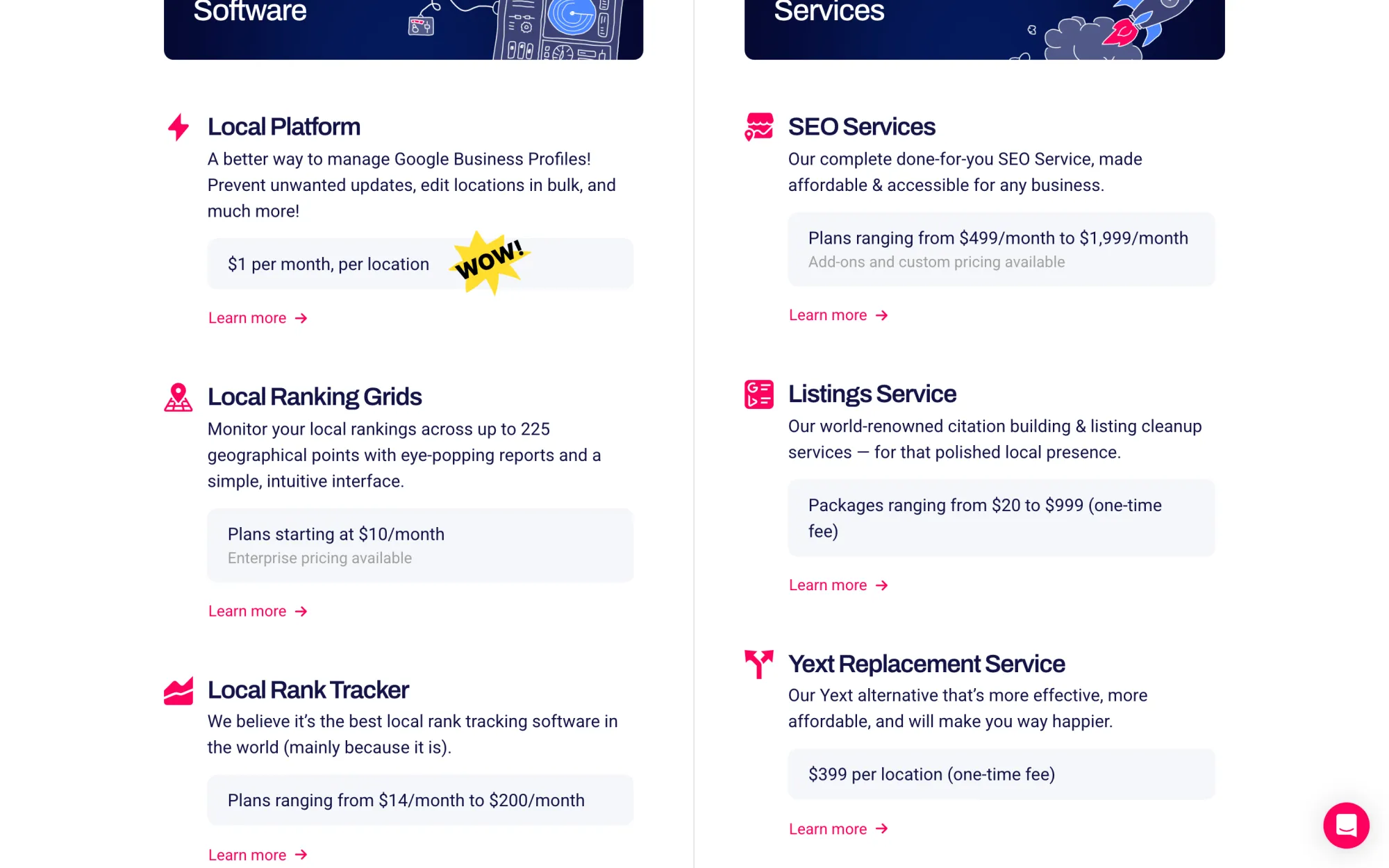
Whitespark built its name on citations, and its pricing page is explicit about the model: the software and services are sold individually, with no forced bundling. The catalog spans the Local Rank Tracker (Local Packs, Maps and organic on Google and Bing), Local Ranking Grids up to 225 points, the Local Citation Finder, Reputation Builder, a $1-per-location Local Platform for GBP management, and services: a managed Listings Service sold as one-time packages, a Yext replacement service, and full SEO engagements.
Pricing model. Per tool: Local Platform $1 a month per location, ranking grids from $10, rank tracker $14 to $200, Citation Finder $33 to $149, Reputation Builder $79 per location; Listings Service one-time packages from $20 to $999 and SEO services $499 to $1,999 a month.
| Whitespark plan | Price | What the page says |
|---|---|---|
| Local Platform | $1/mo per location | GBP management, change digests, bulk reject |
| Local Ranking Grids | from $10/mo | up to 225 geographic points |
| Local Rank Tracker | $14 to $200/mo | Google + Bing, white-label share reports |
| Local Citation Finder | $33 to $149/mo | citation discovery and audit |
| Reputation Builder | $79/mo per location | reviews across 100+ sites |
| Listings Service | $20 to $999 one-time | managed cleanup and submission |
Tier facts rendered from whitespark.ca/pricing, August 2026.
03
What Yext is
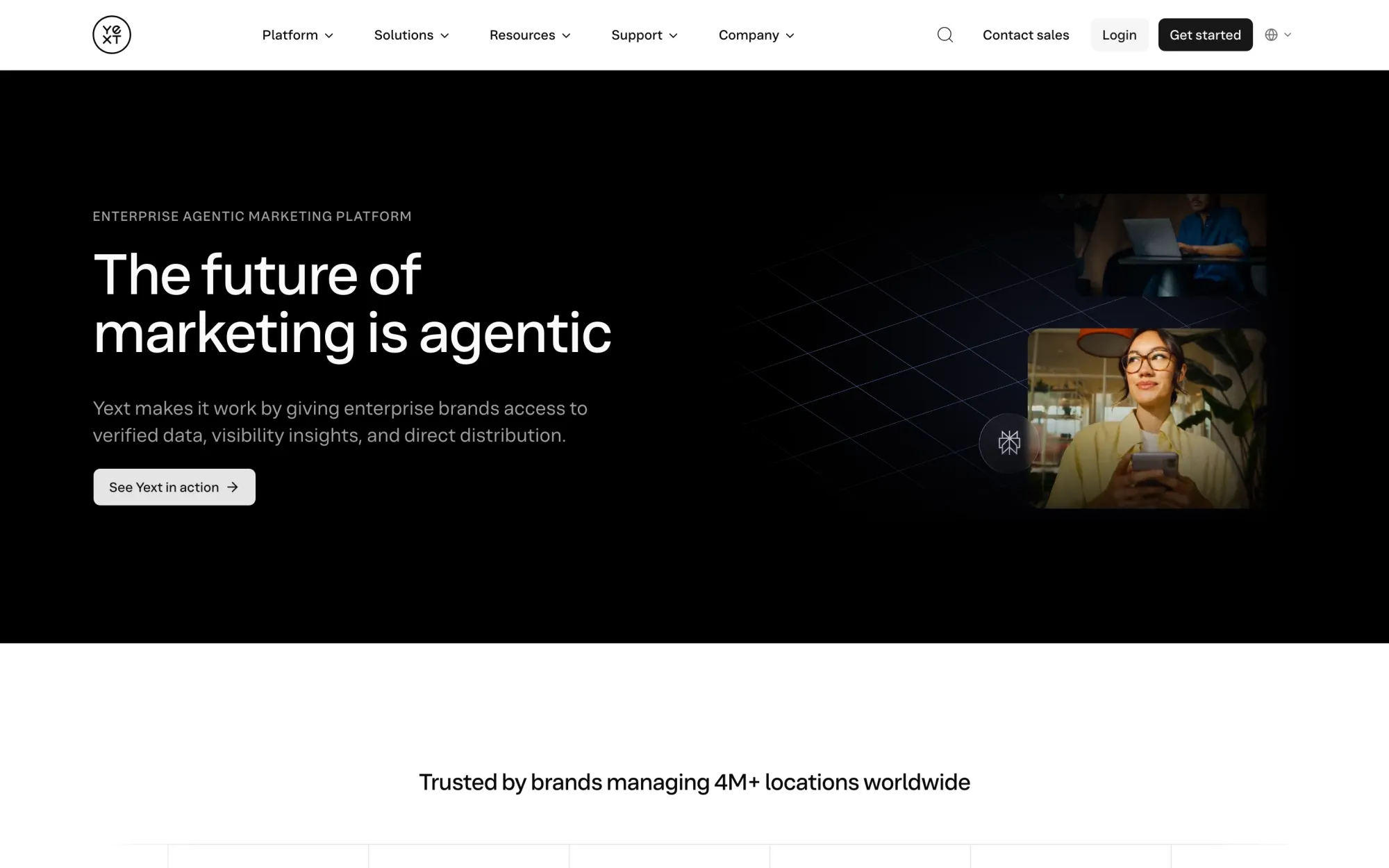
Yext built the category for managed business data at enterprise scale. Its platform navigation lists Scout, Listings, Knowledge Graph, Reviews, Social, Pages, Search, Hearsay Social, Hearsay Relate and Yext AI, with industry solutions for financial services, healthcare, retail, food and hospitality. The model: the Knowledge Graph holds the verified facts about every location, Listings syndicates them everywhere that matters, Pages hosts location landing pages, and Reviews and social tools manage the conversation around them.
Pricing model. Demo-led; yext.com/pricing returned a page-not-found when rendered, so no dollar figure is claimable from their public site.
| Yext plan | Price | What the page says |
|---|---|---|
| Platform | No price published | /pricing 404s; every CTA is Get a Demo |
Tier facts rendered from yext.com, August 2026.
04
AI engine coverage
Whitespark. No AI answer engine appears anywhere on Whitespark's public surfaces: the rank tracker page covers Local Packs, Maps and organic results in Google and Bing on desktop and mobile, and neither the pricing page nor the tracker page mentions ChatGPT, Claude, Gemini or any other assistant.
Yext. Scout appears in the platform navigation as Yext's AI search product; its engine list and tracking depth are not described on the rendered pages, so specifics need verification with their team. No named AI engines appear on the pages we rendered.
Summarized: Whitespark reads none on any surface; Yext reads scout listed; scope not described publicly. On Claude specifically, Whitespark: no; Yext: not stated.
05
Tracking and measurement mechanics
Whitespark. The Local Rank Tracker follows Google and Bing rankings with white-label reporting via unique share URLs, and agencies can serve reports from a custom domain such as rankings.yoursite.com. Local Ranking Grids run the map-grid measurement as a separate product from $10 a month, up to 225 points per scan.
Yext. The platform's discipline is data consistency across the ecosystem: syndicating verified facts from the Knowledge Graph to directories, search engines and maps. Position measurement in the rank-tracking sense appears nowhere on the rendered public pages.
06
Content production
Whitespark. There is no self-serve content product; writing appears only inside SEO Services engagements, which the pricing page lists at $499 to $1,999 a month, done by their team.
Yext. Pages is the content surface: location landing pages generated and hosted from Knowledge Graph data at scale, common in multi-hundred-location deployments. There is no long-form article product on the rendered pages.
07
SEO and local coverage
Whitespark. Citations are the flagship: the Citation Finder discovers directories and audits NAP consistency, and the Listings Service has an in-house team doing one-time cleanup and submission from $20 to $999, with the citations owned once built. Reputation Builder monitors 100+ review sites and runs branded review requests over email, SMS and tablet or kiosk modes at $79 per month per location.
Yext. Listings syndication for large location counts is the core: one source of truth pushed everywhere, with Reviews for monitoring and response and industry-specific solutions layered on. This is distribution infrastructure more than measurement tooling.
08
Data access, APIs and integrations
Whitespark. Neither the pricing page nor the rank tracker page mentions an API or an MCP server. Reporting depth comes through the white-label share URLs and custom domains on agency plans.
Yext. Platform APIs are documented (Point and Click, SDK, APIs per their documentation section) and the Knowledge Graph is the structured-data asset underlying everything. Evaluation runs through enterprise demos.
09
The full ledger
Every cell below was read from the vendors’ own rendered pages as of August 2026. Where a vendor’s public pages neither confirm nor deny a capability, the cell says so.
| Dimension | Whitespark | Yext |
|---|---|---|
| AI engines | None on any surface | Scout listed; scope not described publicly |
| Claude coverage | No | Not stated |
| Tracking cadence | Google and Bing tracking; grids to 225 points | Data sync, not position measurement |
| Google rank tracking | Yes (Local Pack, Maps, organic; plus Bing) | Not listed |
| Local / map tracking | Core: grids, citations, reputation, listings | Listings distribution at enterprise scale |
| Content output | Only inside SEO Services engagements ($499 to $1,999/mo) | Pages product (location landing pages) |
| CMS publishing | No | Own Pages platform |
| API / MCP | No mention of API or MCP | APIs documented for the platform |
| Entry price | From $10 to $14/mo per tool | Demo call; /pricing 404s |
Sources: whitespark.ca/pricing, /local-rank-tracker, /reputation-builder; yext.com (pricing URL 404s). Rendered in a browser, August 2026.
10
Frequently asked
What is the core difference between Whitespark and Yext?
How does Whitespark's pricing compare to Yext's?
Which AI engines does each cover?
Who should pick Whitespark?
Who should pick Yext?
How does Rank.ai compare to Whitespark and Yext?
How each compares to Rank.ai
We keep our own product out of this comparison. If you want the same verified treatment with Rank.ai in the frame, the one-on-one guides for Whitespark and Yext carry it.