Compared
MarketMuse vs Moz
MarketMuse is a content strategy platform; Moz is a SEO suite. This guide compares the two in depth, engine coverage, tracking mechanics, content production, SEO and local surfaces, data access and full pricing tiers, using only facts read from their live pages.
01
The short answer
MarketMuse, part of Siteimprove, models Google's results pages: topic modeling with personalized difficulty, research-backed briefs, draft scoring against the top 20, and site-wide content inventory. Moz, a Ziff Davis company, is the veteran SEO suite: Domain Authority, a 40-trillion-link index, keyword research, site crawls, and an AI module tracking two to three models weekly. They compete only where the categories overlap, and the chapters below walk every dimension a buyer would price: which AI engines each can see, how the tracking actually meters, what each produces on the content side, what surrounds the core product, and the full published tier lists.
Choose MarketMuse when
- Site-wide content inventory with decay tracking
- Topic models with difficulty personalized to your domain
- 1:1 draft scoring with E-E-A-T signal measurement
- All nine brief types on the Strategy tier
Choose Moz when
- Domain Authority and Brand Authority metrics
- A 40T-link index and 1.25B-keyword research base
- Moz Local handles listings distribution
- Moz Academy and a deep learning ecosystem
02
What MarketMuse is
MarketMuse, now by Siteimprove, is a content strategy platform with a decade of iteration on modeling Google's results pages: Topic Navigator, SERP x-ray, SERP and Site Heatmaps, topic models that produce difficulty scores personalized to your domain, and a Content Inventory that crawls your whole site and tracks decay. Its Optimize product scores a page one-to-one against the top 20 ranking pages with E-E-A-T signal measurement, and its brief generator produces research-backed briefs in nine types on the top tier.
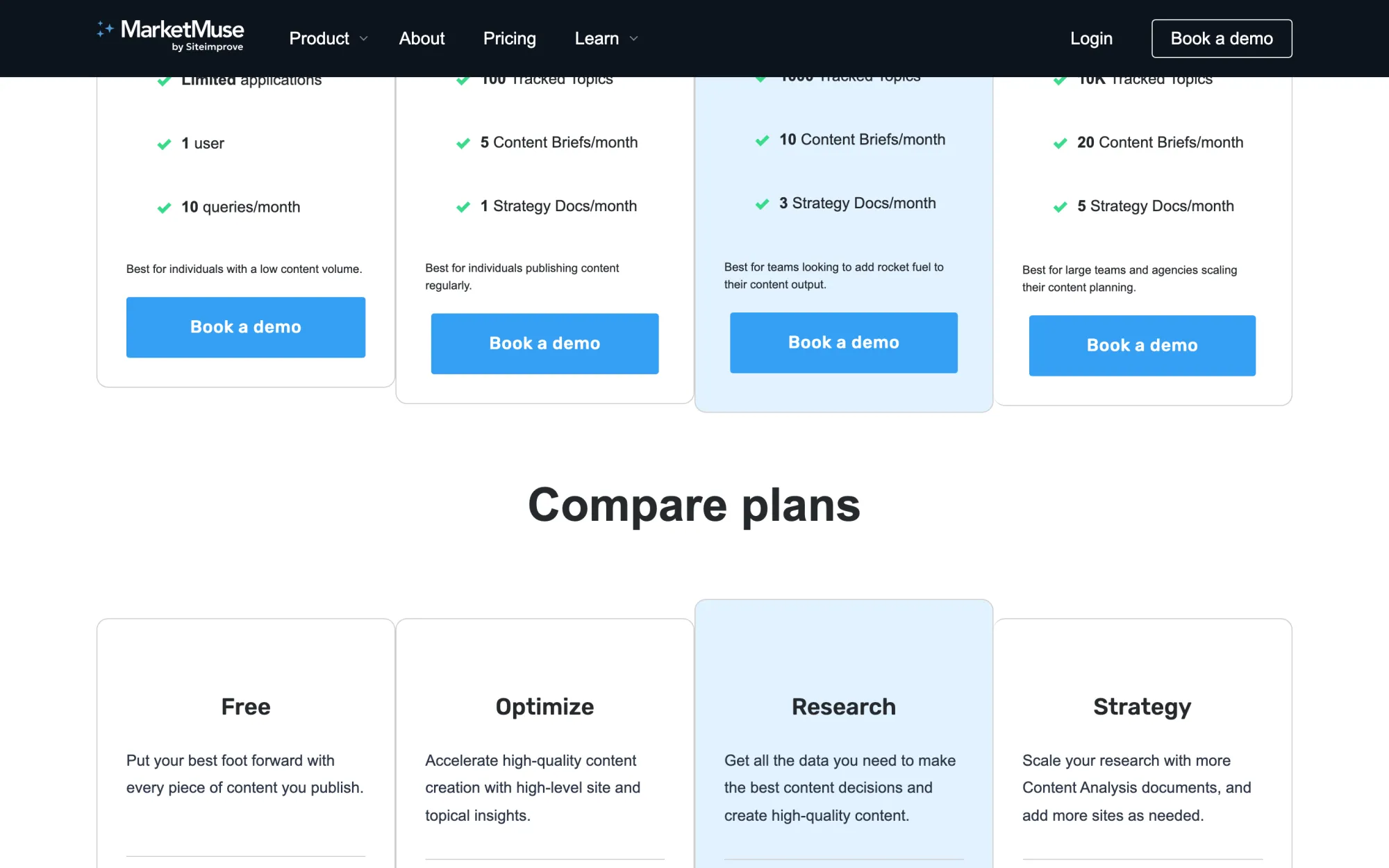
Pricing model. Four tiers, Free, Optimize, Research and Strategy, metered by tracked topics (10 queries a month free, 100 to 10,000 topics paid) and content briefs (5 to 20 a month); no dollar figures are published and every tier's button, including Free's, books a demo.
| MarketMuse plan | Price | What the page says |
|---|---|---|
| Free | No price published | 1 user, 10 queries/month; demo call to start |
| Optimize | No price published | 100 tracked topics, 5 briefs/mo, 1 strategy doc |
| Research | No price published | 1,000 topics, 10 briefs, unlimited queries |
| Strategy | No price published | 10K topics, 20 briefs, all 9 brief types |
Tier facts rendered from marketmuse.com/pricing, August 2026.
03
What Moz is
Moz was the first name in SEO software and remains one of the most trusted, now a Ziff Davis company, with Domain Authority and Brand Authority as industry-standard metrics, a link index past 40 trillion links, a 1.25B-keyword research base, and Moz Academy behind it. Moz Pro carries the suite: keyword research, competitive research, site crawls up to 1.25M pages a week, weekly rank tracking, and a new AI and GEO feature set with visibility dashboards, prompt tracking, citations data and content briefs. Moz Local and STAT sell separately for listings management and enterprise SERP tracking.
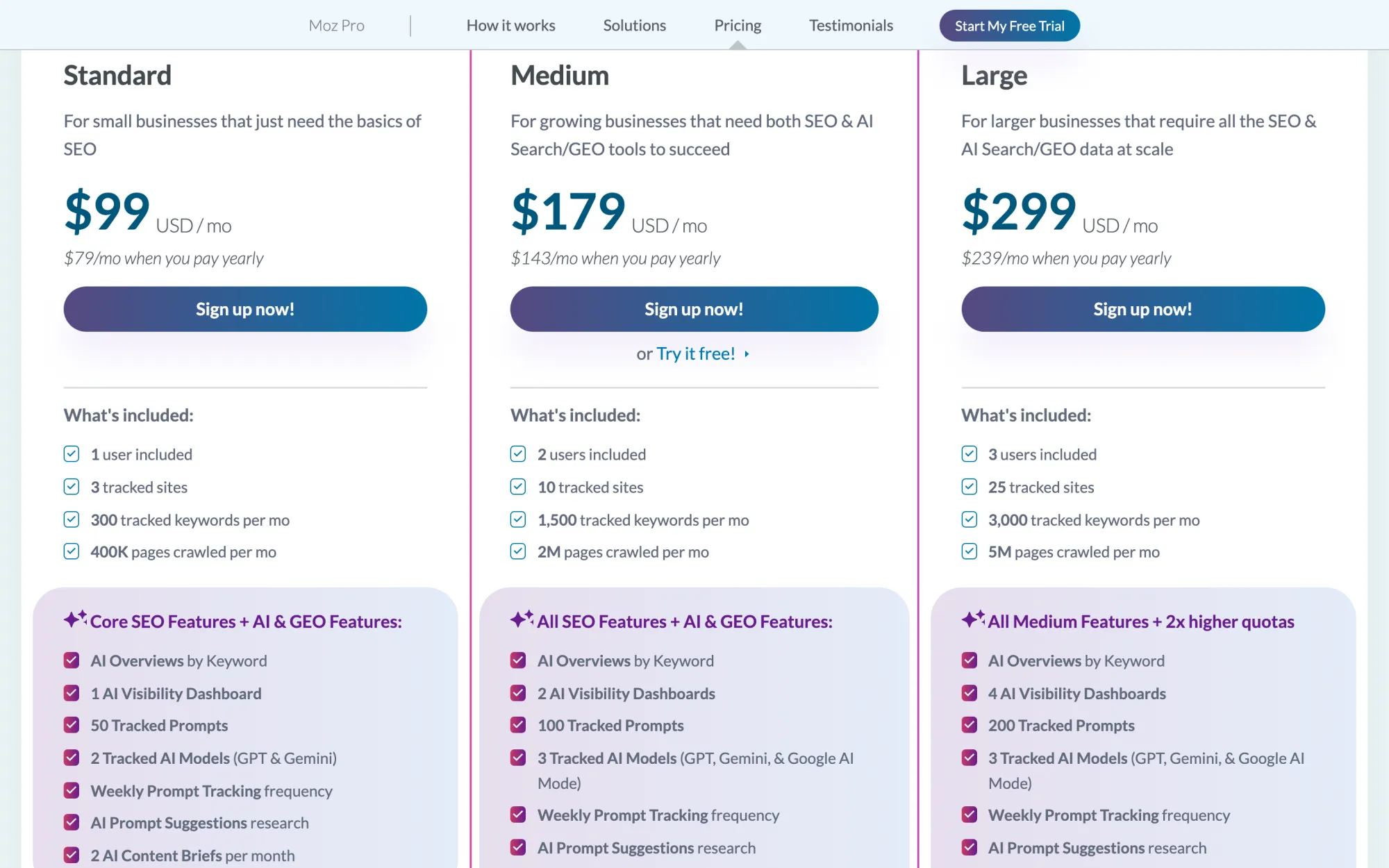
Pricing model. Standard $99, Medium $179 and Large $299 a month (20% off yearly: $79, $143, $239), with a $49 single-site starter plan; extra AI prompts cost $50 per 100, extra dashboards $20 each, and add-on seats $49 per user.
| Moz plan | Price | What the page says |
|---|---|---|
| Starter | $49/mo | single website |
| Standard | $99/mo | 50 prompts, 2 models (GPT, Gemini), weekly; 2 briefs/mo |
| Medium | $179/mo | 100 prompts, 3 models (+ AI Mode); 10 briefs; free trial |
| Large | $299/mo | 200 prompts, 3 models; 50 briefs; branded reports |
Tier facts rendered from moz.com/products/pro/pricing, August 2026.
04
AI engine coverage
MarketMuse. No AI answer engine appears anywhere on MarketMuse's public pages: no ChatGPT, Claude, Gemini, Perplexity or AI Overviews. The platform's entire measurement surface is Google's results pages.
Moz. The tracked AI models are GPT and Gemini on the $99 Standard plan, with Google AI Mode joining from the $179 Medium plan, three models at most. Claude, Perplexity, Grok and DeepSeek appear nowhere in the tracked-model lists on the Moz Pro pricing page.
Summarized: MarketMuse reads none; the surface is Google's SERPs; Moz reads 2 (GPT, Gemini) on $99; 3 (+ AI Mode) from $179. On Claude specifically, MarketMuse: no; Moz: not listed.
05
Tracking and measurement mechanics
MarketMuse. Measurement is SERP analysis at depth: SERP x-ray and heatmaps, topic models with personalized difficulty, and the Content Inventory crawling your site to flag decay. There is no position tracker in the rank-tracking sense and no answer recording.
Moz. Both halves of tracking run weekly: AI prompt tracking frequency reads weekly on every tier, and the rank tracker checks each keyword weekly across Google US and international, Google Mobile, Yahoo and Bing, with 300 to 3,000 keywords by tier. AI citations data and prompt suggestions ship on every tier, and extra prompts are $50 per 100.
06
Content production
MarketMuse. Briefs are the product: structure, subtopics, questions and linking suggestions, research-backed, metered per month by tier, with draft scoring against the top-20 pages. Output exports to Google Docs or MS Word for your writers; there is no CMS publishing, so the distance from brief to published page runs through your team.
Moz. Content output is AI Content Briefs: 2 a month on Standard, 10 on Medium, 50 on Large. There is no article writer and no CMS publishing; briefs hand off to your writers.
07
SEO and local coverage
MarketMuse. There is no local product: no map tracking, no GBP tooling, no citations.
Moz. Moz Pro carries the classic research stack with Domain Authority at its center, plus site crawls to 1.25M pages a week and an On-Page Grader. Local is a separate product, Moz Local, which syncs listings to directories; its pricing did not render dollar figures when checked, and no geo-grid appears on the Moz Pro page.
08
Data access, APIs and integrations
MarketMuse. No public API documentation exists (the /api page 404s and the developer subdomain refused connections when checked) and no MCP server is listed. Exports cover saved writing, applications and documents.
Moz. The Moz API sells separately with its own flexible pricing, and no MCP server is listed. Branded reports and report templates arrive on the Large tier, and MozBar Premium ships with every plan.
09
The full ledger
Every cell below was read from the vendors’ own rendered pages as of August 2026. Where a vendor’s public pages neither confirm nor deny a capability, the cell says so.
| Dimension | MarketMuse | Moz |
|---|---|---|
| AI engines | None; the surface is Google's SERPs | 2 (GPT, Gemini) on $99; 3 (+ AI Mode) from $179 |
| Claude coverage | No | Not listed |
| Tracking cadence | SERP analysis, not answer tracking | Weekly for both AI prompts and rankings |
| Google rank tracking | SERP modeling, no position tracker | Yes, weekly, across Google, Mobile, Yahoo, Bing |
| Local / map tracking | None | Moz Local (separate listings product) |
| Content output | Briefs and scored drafts, exported to Docs/Word | AI Content Briefs, 2 to 50/mo |
| CMS publishing | No (exports to Google Docs / MS Word) | No |
| API / MCP | No public API docs; no MCP | Moz API (separate product); no MCP listed |
| Entry price | Demo call required, including for Free | $49/mo single-site plan |
Sources: marketmuse.com/pricing and product pages; moz.com/products/pro/pricing and /products/local. Rendered in a browser, August 2026.
10
Frequently asked
What is the core difference between MarketMuse and Moz?
How does MarketMuse's pricing compare to Moz's?
Which AI engines does each cover?
Who should pick MarketMuse?
Who should pick Moz?
How does Rank.ai compare to MarketMuse and Moz?
How each compares to Rank.ai
We keep our own product out of this comparison. If you want the same verified treatment with Rank.ai in the frame, the one-on-one guides for MarketMuse and Moz carry it.