Compared
Rank.ai vs Surfer
Surfer scores your draft against the pages ranking on Google. Rank.ai records what seven AI engines answer when your buyers ask, then writes and publishes the pages those answers are missing. This guide walks both products screen by screen, with prices from their live pricing page and ours.
01
The short answer
Surfer is a content optimization platform. Its Content Editor grades a draft against the pages already ranking on Google for one keyword, and that live scoring loop is genuinely the deepest of its kind. Everything else on this page is about what surrounds that loop. Surfer tracks five AI engines and its list stops before Claude, Grok and DeepSeek. It ships no local rank tracking of any kind. Its workflow ends when your writer accepts a score. Rank.ai tracks seven AI engines daily, records every answer with its cited sources on boards anyone can open, tracks Google and local map rankings on the same login, and finishes the job by writing the missing pages and publishing them into your CMS once you approve them.
Choose Rank.ai when
- The workflow should end with a published page, and a tracker verifying it
- Claude, Grok and DeepSeek answers matter to your buyers
- Local map rankings belong on the same bill
- You want a $0 plan that publishes 10 articles a month
Choose Surfer when
- A live draft-scoring editor for human writers is the core need
- Google AI Mode tracking is a requirement
- Your writers live in Google Docs and want the extension
- A REST API today outweighs a roadmap one
02
What each platform does
Surfer’s center is the Content Editor: term recommendations and structural targets scored live against the SERP while a human writes. Around it sit Surfer AI drafting, a plagiarism checker, an AI Tracker for brand mentions, and integrations with WordPress, Google Docs, Contentful and Zapier.

Rank.ai is built around a different center: the recorded answer. Seven engines are asked your market’s buying questions daily, every answer is stored with its brands and citations, the gaps feed article briefs, and the pipeline publishes the finished pages into WordPress, Webflow, Shopify or WordPress.com. Google rank checks and the geo-grid local tracker run on the same login.
03
Seven engines tracked daily, every answer recorded
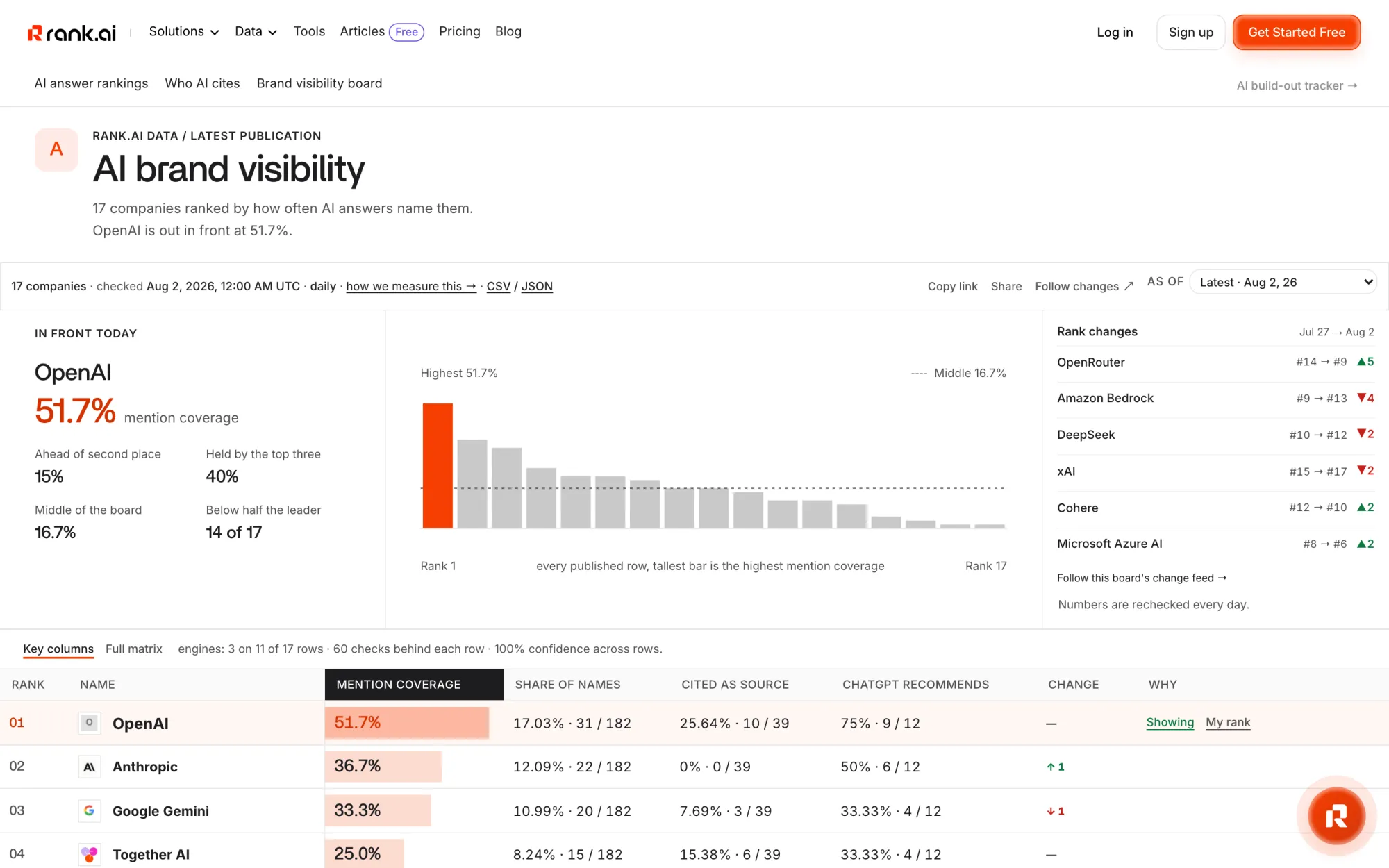
Each question runs as multiple samples per engine, because the same prompt produces different answers on different runs and a single sample would be noise. And each run stores far more than a score: the full answer text, every brand named with its exact character position and a sentiment call on that specific mention, every source URL cited with its position and whether it belongs to you or a tracked competitor, and, for engines that search the web before answering, the Google queries the model issued under the hood, which tells you the exact searches your page has to win to get into tomorrow’s answer.
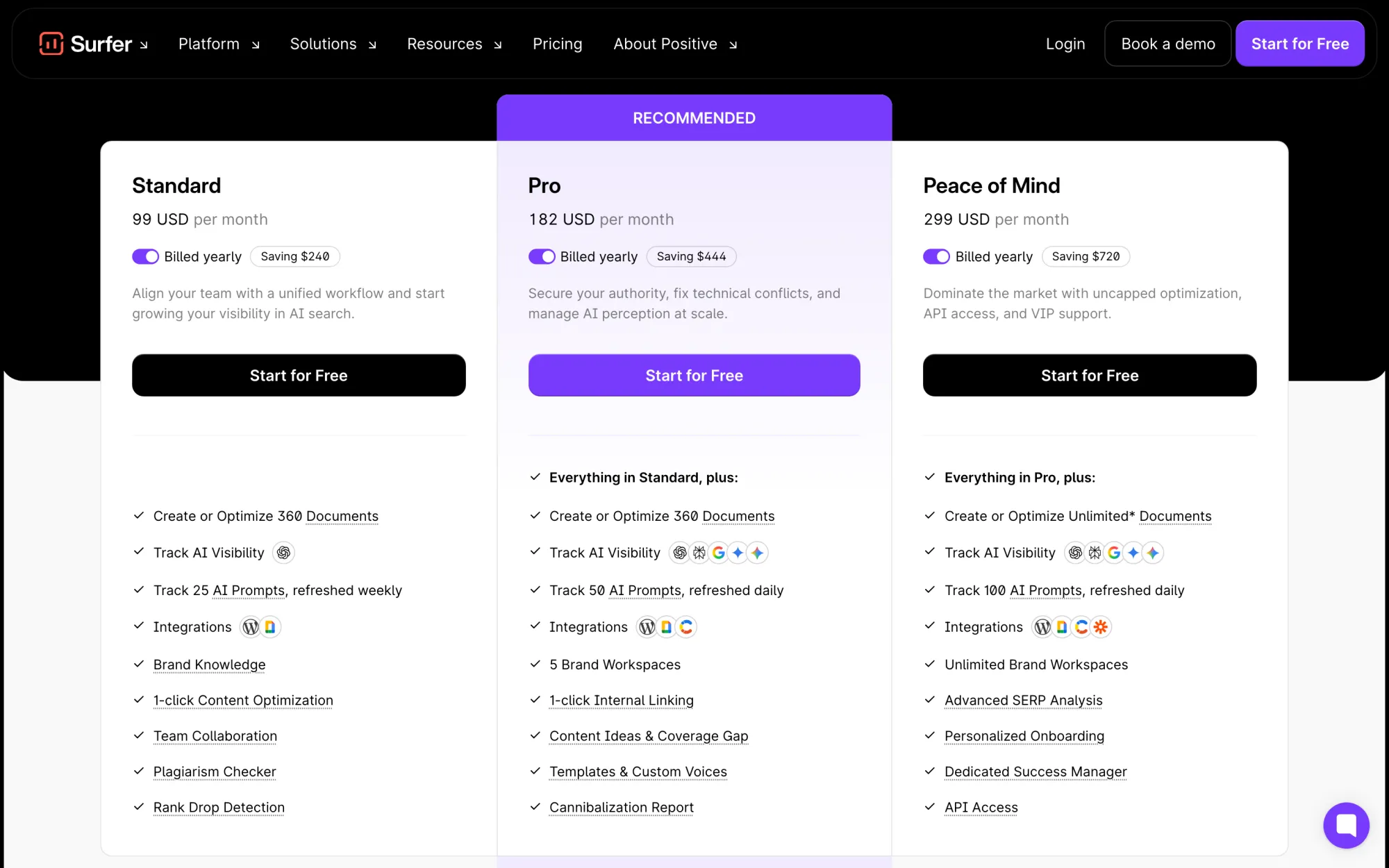
That record is what turns a metric into a diagnosis. When Gemini stops naming you on Tuesday, you open Tuesday’s answer, read the sentence that replaced you, and see the competitor page it cited. A trend line alone can never tell you that. Surfer’s AI Tracker list stops at five engines, and on its $99 Standard tier the 25 tracked prompts refresh weekly; daily refresh starts at $182. Ours refresh daily on every plan that tracks AI answers.
04
From accepted score to published page
Ask a Surfer user what happens after the score turns green and the answer is a checklist: export the draft, paste it into the CMS, rebuild the formatting, find images, add links, publish, and then open a rank tracker to find out weeks later whether any of it mattered. That checklist is the actual cost of a scoring tool, and it is paid on every single article.
Rank.ai replaces the checklist with settings you write down once. You set how many articles publish per week and the pipeline holds that cadence. You set the themes it draws topics from, and give it title and style direction in plain text. You paste in examples of your own writing and the drafts follow that voice. You list your competitor domains once and the writer is hard-blocked from ever linking to any of them, subdomains included; it even keeps a deny-list of your own practitioners’ names so a bio mention can never be hyperlinked to a rival practice. Images are generated per section on your brand palette. Then you choose the gate: approve each article by hand, or let approved settings publish on schedule. Monday morning after switching, the queue has drafts waiting and the only job left is reading them.
05
Local map rankings on the same login
Surfer has no local surface: no Google Maps tracking, no geo-grid, no Google Business Profile monitoring, no citations. If any of your revenue arrives through a map pack, that entire battlefield is outside the product. Rank.ai’s local rank tracker places a grid of probe points across your service area and checks your map-pack rank from each point, refreshed daily, with each tracked competitor’s rank recorded on the same grid. One credit per grid point, so a 3x3 scan costs 9 credits and a 10x10 costs 100. It tracks Google Maps and Apple Maps, grades your Business Profile, and monitors your directory citations. Agencies with local clients get the AI answer record and the map grid in one account, which is one report and one bill where two tools used to be.
06
Pricing in practice
Surfer’s page lists Discovery $49, Standard $99, Pro $182 and Peace of Mind $299 a month, each labeled billed yearly, plus a $999 a month Enterprise plan. AI tracking starts on Standard with 25 prompts refreshed weekly, daily refresh starts on Pro, API access sits on the $299 tier and white-label on Enterprise.
Rank.ai starts at $0 with no card: the free plan publishes 10 articles a month to your connected site and tracks 3 keywords daily. AI answer tracking starts on Starter at $50 a month, refreshed daily on all seven engines, and Pro at $250 raises the limits and adds the MCP server. If you mostly want a draft-scoring editor, Surfer’s metering fits that shape. If you want tracking, diagnosis and published pages on one bill, ours does.
07
The full ledger
Every Surfer cell was verified by loading surferseo.com/pricing in a browser. Every Rank.ai cell was verified against our own code and pricing page. Where we are behind, the ledger says so.
| Capability | Rank.ai | Surfer |
|---|---|---|
| AI engines | ||
| ChatGPT, Gemini + Perplexity tracking | Yes | Yes |
| Google AI Overviews tracking | Yes | Yes |
| Claude rank tracking | Yes | No |
| Grok rank tracking | Yes | No |
| DeepSeek mention tracking | Yes | No |
| Google AI Mode tracking | No | Yes |
| Public daily boards with recorded answers | Yes | No |
| Content | ||
| AI article writing | Yes | Yes |
| Live on-page content scoring against the SERP | Partial | Yes |
| CMS publishing | WordPress, Webflow, Shopify, WordPress.com | WordPress, Contentful |
| Peer-to-peer backlink exchange | Yes | No |
| Local | ||
| Local rank tracking (geo-grid, Google Maps, Apple Maps) | Yes | No |
| Citations monitoring (directories) | Yes | No |
| Platform | ||
| MCP server for AI assistants | Pro plan | No |
| Public API | In roadmap | $299 tier |
| White-label reporting | Agency plans | Enterprise plan |
| Free tools without signup | Yes | Yes |
| Free plan | $0, no card | From $49/mo |
Source: surferseo.com/pricing, rendered in a browser August 2026. Rank.ai cells sourced from backend code and rank.ai/pricing.
08
Frequently asked
What is the core difference between Rank.ai and Surfer?
Is Surfer better at on-page content optimization?
Which AI engines does each platform track?
Do you track Google AI Mode?
Do you have an API?
Do you do white-label reporting?
How does pricing compare?
What do I lose and gain if I switch from Surfer to Rank.ai?
See your AI rankings today
The free plan tracks your Google rankings, publishes 10 articles a month to your site and costs $0 with no card. Run it beside whatever you use today and compare the output.